Chapter Nine
The Future Pulls us Towards It
Station 8 — The Future Pulls us Towards It
In which Influence meets Invocation
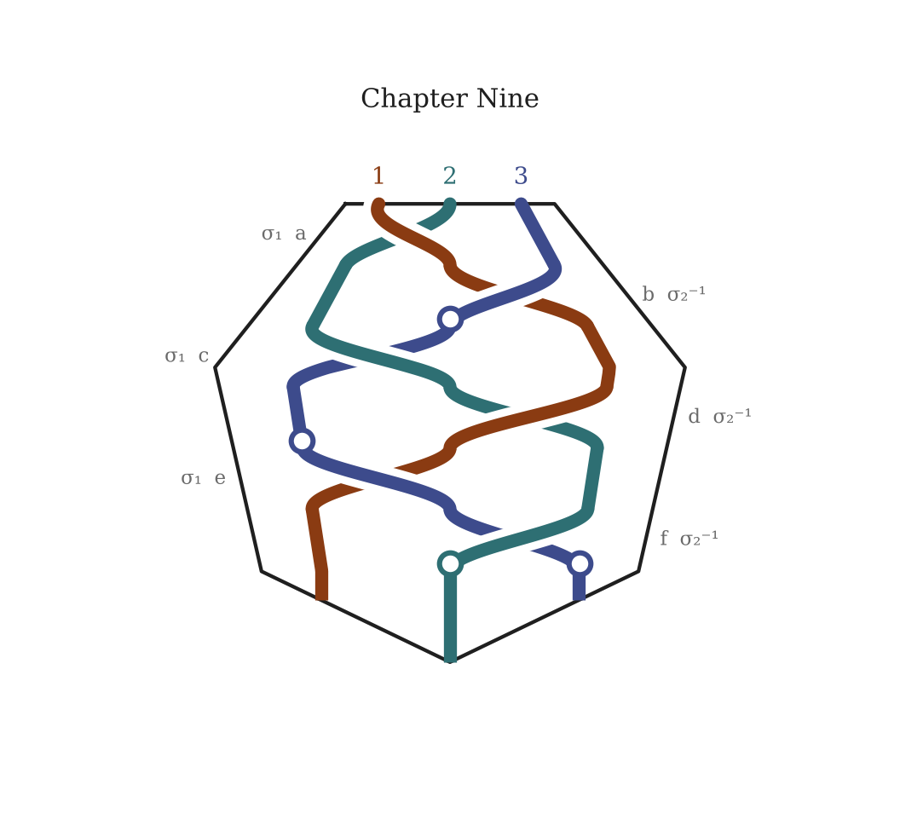
the closure1 2 3 joined
BROOKLYN. THE POWERHOUSE ON KENT AVENUE. FRIDAY, 12:52 AM.
The house lights had been up for an hour and fifty-one minutes, and in that light there was nothing to see.
That was what Boi would remember first, later, when she tried to remember the night in order: how ordinary the room became once it was lit. The Powerhouse had been built in 1904 to make electricity for the sugar refinery next door, and for most of a century it had done nothing else, and then for thirty years it had done nothing at all, and then someone had swept out the pigeons, hung a lighting rig from the old crane rails and started selling tickets. In the dark, with Foundling’s Keeper on the stage and three thousand people breathing, it had been a cathedral. Under the work lights it was a shed. Concrete floor, sticky. Brick painted a municipal green to head height. Tall windows along the river side, black. A skylight down the whole length of the roof, black. And everywhere people sitting on the floor in their coats, in clumps, in the particular silence of a crowd that has been told to wait and has not been told for what.
Boi and Gyrl had the merch table.
Nobody had given it to them. At twenty past eleven, when the first police had finished walking the room and the second police, the ones without uniforms, had not yet arrived, the girl who had been selling T-shirts sat down on the floor behind the table and started to cry. Boi sat down next to her. Twenty minutes later the girl had been let out with the band’s crew and Boi was still there, with the table and the stacked shirts and the monitor on its stand that had spent the evening looping the album art: a blue booth, a hand flat against the glass.
The monitor now showed nine phone feeds at once.
Boi had both laptops open in front of it, and a cable she had bought for forty dollars from a man who sold cables, and an extension lead run from behind the bar. Anything that had gone up before twenty to midnight was still out there, on the platforms, under the hashtags, pinned to the map at the place where it had been shot, and she had been pulling it down for an hour as fast as the venue’s wifi would let her. The rest was coming to her another way. She had put a F1R3FLY node on her laptop months ago, for no reason she could have defended, and at eleven-fifteen she had stood on a chair and told the people near her that if they wanted their video kept somewhere nobody could switch off, they could send it to her from where they sat, and nobody had to hand anything to anyone. Forty-one people had. She had not asked twice.
Gyrl sat on an upturned crate beside her with the headphones on and eyes closed, listening.
At the doors there were milk crates of phones, hundreds of them, each in its own clear bag with a number on it, guarded by two officers who looked as if they would rather be anywhere. Gyrl’s was in one of them. Boi’s was on the table, switched off, because at eleven-nineteen it had lit up with the word DAD and she had looked at it for one ring and turned it off and had not turned it back on.
The sticks were in her back pocket. Nobody had asked for the sticks.
Dark. A girl’s voice, close to the microphone: oh my god, oh my god, is that part of it. The image goes white.
The stage from forty yards. Four figures walk out into blue light. The drummer sits. The singer does not go to the microphone. She stands at the lip of the stage with her hands at her sides and looks at the room, row by row, as if she is counting it.
A loading dock. Cold. A woman in a coat thrown over a stage dress is writing on the back of a sheet of paper, pressing it flat against the brick.
From directly above: the floor, heads and hands and the tops of phones. Near the middle, a ring starting to turn.
“Anything?” Boi said.
Gyrl opened one eye. “Second song. Every clip so far is from the second song or later. Nobody filmed the first one.”
“Why not?”
“Because she didn’t sing it.” Gyrl closed the eye again. “She just stood there. You don’t film someone standing there. You wait.”
On the grid a feed went black, and another came up in its place, and Boi’s program laid it into the empty square with the patience of a machine that did not know what it was looking at. In the corner of her screen a smaller window was running something else: a model she had pulled onto her own laptop that afternoon, because Gyrl would not put anything on anybody’s servers and she had agreed. It did one thing. It read every frame of every feed and listed what was in them. It was slow. It was thorough. It did not guess.
No clip contains the moment Dietrich Maas fell.
Nearest before: 22:58:31 (house camera 4). Nearest after: 22:58:44 (EMT).
Thirteen seconds unaccounted for in all sources.
Boi had read it eleven times. It said the same thing each time. That was the point of it.
The crowd made room for them, and did not know it was doing it.
Victoria had noticed it on the pavement outside, in the queue that ran three blocks down Kent Avenue toward the bridge: people shifting a half step to the left, a half step back, making space without looking up from their phones, the way water makes space for a stone. Inside it was the same. Three thousand people packed shoulder to shoulder in a building meant for a third of them, and wherever she and Balthazar walked there was a path. Nobody pushed. Nobody stepped on her foot. A man holding two beers above his head turned to let them pass and then looked at the place where they had been with a small frown, as if he had felt a draft.
“They can’t see us,” she said.
“They can see us,” said Balthazar. “They just don’t keep us.”
He was doing what he always did in a room: counting it. Exits: four, one of them chained. A balcony along three sides, a catwalk above the stage, a skylight the length of the roof. A sound desk two-thirds of the way back with a man standing at it who was not the engineer. Security on the doors who were not security. A woman in a navy coat by the bar, mid-thirties, a wrist that had lately been in a cast, who was early to everything and had been here since doors. A light, quick person in a band T-shirt from a tour that had never happened, moving through the crowd like someone who knew all of it by name. And standing very still near the sound desk, a tall man with his hands in his pockets whom Balthazar did not know at all, and whom the room around him seemed, faintly, to be listening to.
Victoria had stopped. She was looking up at the stage, where a woman in a grey dress stood at the front with her hands at her sides, not singing.
“Everyone in this room has a reason to be here,” Victoria said, “except us.”
Fifteen feet away, wedged against the barrier, Boi’s lips moved.
She had not meant them to. She had read that line perhaps forty times. It was one of the lines from Age of Consent that people put in their signatures on the forum, and she had always heard it as Victoria being Victoria: dry, a little vain, the kind of thing a woman says when she walks into a room and knows exactly what she is to it. She had mouthed it before Victoria finished saying it, the way the people around her would mouth Kiki’s lyrics all night half a breath ahead of the voice, and she caught herself, and pressed her lips together, and the rest of it arrived anyway, out loud, in a voice she had only ever heard in her head.
“That’s how you know we’re the reason.”
Boi did not turn around. She could not have said how she knew where the voice was. She knew it the way you know where a note is coming from in a dark room. And she understood, with the floor going very slightly wrong under her, that the line was not vain. It had never been vain. It was a measurement. Everyone in this room had come because of a clip on a famous man’s channel, because two kids had said a date and a death and two names. Everyone had a reason. The only people who did not were the two whose names had been said. And Boi, who had filled this room, had a reason too, and it was the same reason, and she did not know any more whether that put her inside the line or outside it.
Beside her Gyrl had stopped moving.
“Did you hear —” Boi said.
“Yes.”
“Where —”
“Don’t look,” said Gyrl. “Whatever you do. Don’t look at them.”
Shaking, but in time. Kick, snare, a hi-hat pattern caught exactly. The singer is at the microphone. Her eyes are not on the crowd. They are on something to the left of camera, low, and she is smiling at someone she has not seen in six years.
A long lens. The singer’s face, close. She sings the first line of the third song to one person. Goro’s voice, under his breath, in Japanese, then in English: she’s singing it to someone.
Horns up, tongue out, mock-ecstatic, an inch from the back of the air drummer’s head. Behind them both, a gap in the crowd. Nobody in it.
Balthazar had not moved since the first verse. He stood with his hands at his sides like the woman on the stage, and Victoria, who had known him through three wars and one very bad dinner in Lisbon, had never once seen his face do what it was doing now.
“I found her singing for coins,” he said. “I’ve been paying for that song ever since.”
“Then you’ll have to hear it to the end.”
Gyrl’s mouth had opened on the end, and shut again.
That one was from the second half of the story, the part the forum called the long night. In the archive it had always read as the tenderest exchange in the series, Balthazar confessing a sentimental debt, Victoria teasing him into honoring it. Gyrl had said the first line aloud at Saltmarsh, in front of the memorabilia wall, under the photograph of Kiki, and Boi had answered with the second and laughed. Nobody was laughing now. Standing in the room where it was being said, Gyrl heard what the archive had never let anyone hear: the arithmetic in it. Paying for a song, and still paying, years later: money didn’t work like that. Time did, in the wood. And to the end did not mean the end of the song. It meant the end of the night. Whatever happened, they were not leaving.
Gyrl reached for Boi’s hand without looking and found it.
1:31 AM.
At half past one the man without a lanyard came out of the production office with the woman in the good coat, and they stood at the side of the stage arguing in the low, furious voices of people who have been trained not to be overheard and are being overheard anyway.
Boi could not hear the words. She could see the shape of it. He had a procedure: the room is sealed, the witnesses are held, the recordings are collected, nobody leaves until everything has been seen by people with the clearance to see it. That was the procedure for a death. It was not the procedure for this, and the woman in the good coat had been telling him so for twenty minutes, in an accent Boi placed somewhere in Central Europe, patiently, as if she had once sat through six sessions of a negotiation across from an empty chair.
At one point the man said, quite loudly, “Whose protocol?”
The woman said something Boi did not catch. The man looked at her. Then he went back into the production office and shut the door.
Two calls had come in to the incident commander in the first hour. Boi knew because the livestreamer, who had filmed everything she could until a policewoman took her phone, had told the people around her, and the people around her had told the merch table, the way news moves through a room that has nothing else to do. Two calls ninety seconds apart, to the man running the doors. He took the first one standing up and the second sitting down. After the second, he walked to the back of the hall, looked at the merch table and the two kids at it for the length of a breath, and told the officer beside him to leave them their laptops and leave the girl her phone, so long as it stayed switched off. The officer asked who had called. The commander said he didn’t know, which was true, and that it had been someone who knew his name, which was worse.
Boi thought about her father. She did not turn on her phone.
“House cameras,” Gyrl said suddenly, opening both eyes.
“What?”
“This building has cameras. Up in the corners. Somebody’s watching them.” Gyrl looked at the production office, then up at the balcony, at a door marked PRIVATE with a light under it. “Somebody else.”
On Boi’s laptop, a message appeared on the channel she had used for two years for difficult questions about obscure documents.
And half the squares on the merch-table monitor went dark, and came back as something else: the venue’s own cameras, eight of them, high and wide and steady, time-coded to the frame.
The next message said:
Boi did not look up. She did not need to. The door marked PRIVATE was at the top of the balcony stairs, and the light under it was on.
From above. The ring is a ring now: forty, sixty, a hundred people running in a circle with their arms thrown wide, the way a pit turns at a heavy show, faster and faster. It is turning around nothing. At its centre there is a clear space, and in the clear space there is no one, and the space has the shape of two people standing close together.
Who’s in the middle? Is somebody down? Hey, who’s in the middle of that?
Laughing, spinning, the camera swinging. Twelve, thirteen, fourteen people pass the lens with their arms out. A man in a crown of antlers goes by. A woman in a gown that seems to be made of moths. A thin boy who winks at the camera and is gone. Behind them all, very faint, the smell of a struck match. Nobody near her is smoking.
They had stepped out of the way of the pit and the pit had come to them.
Victoria felt it turn around her like a tide turning: not a push, a reorganization. Bodies running past on every side, close enough to touch and never touching, and at the centre a space where she and Balthazar stood, wider than the two of them, as if the ring had made room on purpose. She knew, without knowing how she knew, that it was a shape. She had spent her life finding the shapes inside things that would not admit they had any. This one admitted it freely. A ring of runners around two figures standing. If she had drawn it on a blackboard she would have drawn a circle of points and two points inside it, and somebody at the back of the room would have asked her whether the two in the middle were part of the set or what the set was for.
And among the runners, now and then, there were others.
A man with a crown of antlers who looked at her as he passed and inclined his head the way a host does. A woman in a gown that moved like wings, who laughed as she went by, and wherever the laugh fell something opened: the hand of a girl who had kept it in a fist all night, the face of a security guard, a flower somebody had tucked into the cable run at the edge of the stage. Victoria had seen that woman before. In a wood that remembered what it was. In a dream she and Balthazar had both woken from on the same morning, without having to ask each other what it had been.
The phones did not see the woman as anything but a costume. The phones did not see Victoria at all.
The ring turned faster. The bass came up through the concrete, and under the bass there was something else, lower, and Victoria put her hand on Balthazar’s arm.
“Hold on to me,” she said. “Whatever I turn into, hold on.”
He did. He did not ask what she meant.
At the barrier Boi had both hands over her mouth.
That one she had said herself. Out loud, at two in the morning, in a hotel room in New Haven, half asleep and too tired to be careful, the first night she and Gyrl had worked side by side until the words ran out. It was the line everyone loved, the Tam Lin line, the most romantic thing Victoria ever says. She had said it to the ceiling and Gyrl had not answered, and she had lain there afterwards wondering whether she had said something too large.
She looked at Gyrl now. Gyrl was looking at her, and not at the ring, and for a moment the noise of the room went far away.
Whatever I turn into.
She had always heard it as a woman asking to be held through danger. Standing a few feet from the woman saying it, she heard what it was really for. It was not asking to be kept the same. It was asking to be kept. All the way through. Whatever happened to the shape.
Boi took her hands away from her mouth and held on to Gyrl’s arm, hard, and Gyrl let her.
Her face, lit blue and then red. She is not looking at the stage. She is looking down at her own feet. Then she looks straight into the lens and signs, quickly, laughing, frightened: the floor. The floor is singing. Can’t you feel it? The floor.
0.004 g at 39 Hz, sustained. Not the kick drum. Not the bass. Something under both, rising.
The stage, the crowd, the desk lights in the bottom of the frame. In the corner of the shot the tall man by the desk has taken his hands out of his pockets. He leans toward Reyes. He says something. Reyes turns to the engineer and puts a hand flat on the desk, and the engineer looks down at the meters and then up at Reyes, and Reyes says, clearly, close enough to the phone to be heard: is it recording? Make sure it’s recording.
The long lens has left the singer. It is pointed down at the floor, at nothing, at the concrete. Goro is not filming anything. He is listening.
The ceiling. The skylight. Black, and then not black: a light, soft, moving east to west above the glass, slower than any plane. Then another. Then six.
In the merch-table monitor’s bottom right square, the tall man by the sound desk had gone still. He had stood quietly most of the night; this was something else, the thing Boi had seen in the archive a dozen times without knowing what it was. Not frozen. Listening with his whole body, everything in the room arriving at once and none of it crowding him. In the archive it had always been the most beautiful thing in the footage, Bob Coecke by the sound desk, surrounded by people in motion. Now she could hear what he had been hearing.
She had Reyes’s phone feed. She had Reyes’s board, too, on a drive Reyes had walked over to her at five past eleven, before anyone thought to ask for it, and put in her hand, and said: “I lost my head once. Not tonight.” She had the stick data. She had the Deaf woman, who had felt it before anyone heard it. She had a grandfather who had filmed the ceiling all night because he held the phone the wrong way up, and whose ceiling was full of lights.
She had three thousand people who would tell the police tomorrow that the bass had done something strange around half past ten, and that was all.
Feedback. A lighting rig. A stunt.
On the merch table Gyrl had taken the headphones off and was holding them away from both ears, listening to Reyes’s board with them at arm’s length.
“It’s not a note,” Gyrl said.
“What is it?”
“It’s a lot of notes. Stacked up. Spread out.” Gyrl was quiet for a moment. “None of them sit too close together. Like a voicing that won’t let any two notes touch.” A pause. “Goro would know what that is.”
Goro was sitting on the floor by the bar with his camera in a numbered bag in his lap, where a policeman had let him keep it, and his hands folded on top of it. He had been sitting like that for an hour. He was looking at Boi. When she looked back he lifted one hand a little, the way he used to on the stairs when she was nine and had finally heard both rhythms at once.
No horns now. She has stopped moving, and the camera is on a man in his forties who stands beside her with a laminated board of letters held up in one hand. A woman of about the same age stands at his shoulder, not touching him. He points.
L
E
T
They had come to the barrier because the crowd had parted for them, and they had stopped because the crowd had stopped, and when Victoria turned around the two young people from Columbia were standing directly in front of her.
She knew them at once. The girl with the drumsticks, the one who had looked straight at her in a lecture hall and gone on past. The tall one with the guitar case, who had found the same two words on the other channel. Her correspondents. They were not looking at her. They were very carefully looking at a point on the floor just to the left of her feet, as people do who have been told not to look.
“You’ve come a long way,” Victoria said.
“From Providence,” said the girl, to the floor. “And — Chicago. Mostly.”
Victoria waited. She did not know why she was waiting. There was a silence in the line, and the silence seemed to want something.
“We came because someone’s going to die,” said the girl.
“Not him,” Victoria said. “Not me either.”
She heard herself say it and did not know where it had come from. The tall one’s eyes closed briefly.
“Then you already know how this ends,” said Victoria.
“We know how it ends in the story,” said the girl.
And there it was: a word, laid down in front of her like a card on a table. The story. Victoria looked at the girl, at the sticks in her back pocket, at the tall one’s hand gripping the girl’s arm, at their mouths, which were both moving very slightly, as if they were singing along to something under their breath. She thought of a video on a famous man’s channel, a girl saying her name. She thought of three words in pencil on the back of a photograph. She thought: they know the words. They know what I’m going to say.
“If you know the next line,” Victoria said, “don’t say it. Let me.”
H E R
H E A R
I T
Boi saw the man with the letter board.
She did not know him. She had never seen his face. A man of perhaps forty-five, grey at the temples, and beside him, not touching him, a woman with the steadiest eyes Boi had ever seen. When the woman looked at her, Boi felt something in her chest, the way she had once felt a voice there, on a hill that was not a hill, telling her not to let go. He was holding the board up, out of the crowd, toward her, and pointing, a letter at a time, and the strobe from the stage caught each letter alone. LET. HER. HEAR. IT.
She knew the next line. Of course she knew it. Everybody knew it. It was the last thing Victoria says before the long night begins, and it was on mugs.
Don’t say it. Let me.
Let her hear it.
Boi looked up from the floor for the first time, straight at the woman in the amber jacket whom no camera in the building could keep, and said it first, quietly, like handing back something dropped.
“We’re not here to stop it. We’re here to be the ones who saw.”
Victoria heard it.
The music went on. The ring went on turning somewhere behind her. And Victoria Ashford-Crane stood at the barrier of a concert in Brooklyn and understood that she was told. That there were words for her that she had not chosen, and a girl in front of her who had read them, and that the next thing out of her mouth was already written down somewhere, on paper from a mill that had closed in 1987, in seventeen places on four continents at once. She could refuse it. She could say anything at all. She could feel the whole room waiting to see if she would.
And then something in her let go of holding the decision at arm’s length. She was all there, every year of her, awake to every word, and the story was all there too, running through her the way the bass ran through the floor, and for the length of a breath there was no difference between the two that mattered.
She looked at Balthazar. Balthazar was looking at her, and did not say a word. It was the most generous thing he had ever done.
“We’re not here to stop it,” Victoria said slowly, choosing every word, as if she had found them herself. “We’re here to be the ones who saw.”
Gyrl let out a breath.
Then Victoria said something that was not in the archive. Boi knew it was not, because she knew the archive, and because she felt it like a missing stair underfoot.
“What are your names?”
Boi told her. The bass came up through the floor and took most of it, and the drummer hit the crash, and the strobe went white, and whether Victoria heard it Boi would never know.
He has been told three times to make people stop filming. He is filming. The camera shakes as he climbs. A man is pushing through the crowd below, against the current, toward the barrier: grey suit, sleeves rolled to the elbow, something flat and black held against his chest with both hands.
Goro, filming. Then Goro lowering the camera. Then Goro’s face, which is the face of a man who has spent forty years believing something he could not prove, and who has just seen it walk past him.
A woman’s face, close, astonished, both hands over her mouth. A ring box held up into the frame from below. A man’s voice, shaking: so, um. So. Behind her, out of focus, a man in a grey suit stops in front of a space where there is no one, and lifts a black mirror, and looks into it.
High, wide, steady. The barrier. A man in a grey suit speaking to the air.
He could see her. That was the first thing.
Everyone else in the building had looked at Victoria as if she were a draft. Dietrich Maas looked at her like a man who had been looking for her in a dark glass for twenty years. He held the mirror against his chest like a man holding a child, and when he lifted it his hands shook, and she saw herself in it, which she had not done in any window or phone or puddle all night, and beside her Balthazar, and behind them both the ring still turning.
“I am sorry,” Maas said, “I could not say this to your face.”
He was thinner than in Vienna. His sleeves were rolled. On the inside of his left forearm, in a line of script so fine it was almost calligraphy, she could see the word Göttingen.
“Say it now,” said Victoria.
“I never took it.” He was speaking quickly, as if he were being timed. “Your work. They said I stole it from your papers. I never touched your papers. I saw it. I see things. I saw your proof before you wrote it, and I built two treaties on a vision, and a vision isn’t a proof, and they knew that, and they needed yours.” He took a breath. “I am sorry about Monaco. I am sorry it was not me. I am sorry that it is.”
“Dietrich —”
“The window closes tonight,” said Maas. “I knew that, too. I came anyway.” He looked down at the mirror in his hands, and then up at her, and smiled with great sweetness and no hope at all. “Someone has to be holding it.”
The strobe went white.
The barrier. Maas, the mirror, the light.
A man on his back on the concrete. A woman’s hands on his chest, pushing, counting. Her voice, very calm: get me space, get me space, somebody get the house lights. A smell, she says later, like almonds, or like nothing at all.
Thirteen seconds.
When the light came back Maas was on the floor and a woman in scrubs under her coat was kneeling over him, and Balthazar was kneeling on his other side. He did not touch the woman’s hands. He reached across and turned back the left sleeve, though it was already turned back, as if he had to do it himself to believe it. The line of script was there. Göttingen, and a year.
In Monaco the body had had no mark.
This one did.
Balthazar looked up at Victoria, and she knew what he was going to say before he said it, and for once in her life she did not want to be right.
“It’s him,” he said. “This time it’s him.”
The mirror on the concrete beside the body, face up, reflecting the lights.
Out of focus, low in the frame: a woman’s hand picks the mirror up off the floor.
A woman, side on, walking away fast with something flat and black under her coat. Grey eyes. Sixty, perhaps.
The same woman, the same second. Thirty. Dark eyes. Laughing.
A woman. Back to camera. A plain coat. A book under her arm with a blank spine.
The house lights come up. The music stops in the middle of a bar. Three thousand faces turn toward the doors as the doors are shut.
2:47 AM.
By a quarter to three Boi had stopped expecting anything to happen and the wall had become a place where she lived.
Thirty-six squares now. The house cameras in the top two rows, steady as clocks; Reyes’s fixed shot in the middle, because everything else could be lined up against it; the air drummer, who was the metronome, because the air drummer had played every beat of the set on nothing and every beat was there in their footage like a pulse; the photobomber, whom Gyrl used to stitch the others together, because she turned up somewhere in fourteen other people’s videos and every one of them gave her away by a second here and a second there. Gyrl did the rest by ear. Four bars of anything and Gyrl could say where in the set it fell, which song, which bar, faster than any software Boi had ever written. The music was the clock.
Upstairs, behind the door marked PRIVATE, someone else was doing the same thing with the house cameras and a different kind of patience. The messages came in at intervals on the other channel, short, dry, exact.
And once, at two-twenty, with nothing else around it:
Boi read that one more times than she could have explained.
Some of them had come to the table to give their phones up and some of them had been made to, and the difference had turned out to matter more than anything else about them. The usher who had been told to stop people filming, and had not, came over with his phone in his hand at one in the morning and gave it to Boi before an officer could give it to a bag, and said he had a daughter who would have wanted him to. The lighting tech came down from the catwalk at half past one, white, and sat on the floor by the merch table with his footage open on his phone, and said over and over to anyone who would listen: that light over the crowd, the one at ten-thirty, that wasn’t one of mine, I know every light in this rig, that was not one of mine. The livestreamer’s phone was in a bag by the door, but two hundred and fourteen people had watched it live and some of them had recorded their screens, and the feed was out on the network with every frame where she had put it, and nobody could switch the network off because there was nowhere to switch it off from. The EMT came at two, still in her coat, with blood on one cuff, and sat down next to Gyrl and said: “I’ve done a lot of these. I’ve never had one where I didn’t see him fall. I was looking right at him. I didn’t see him fall.” The grandfather would not give his phone to anyone. He sat at the end of the table and showed Boi the ceiling on it, over and over, and said his granddaughter had bought him the ticket because she said he needed to get out more, and he had held it the wrong way up the whole time, and wasn’t that something, and look at that, look at the lights.
Two of them had not come at all. The man with the letter board and the woman beside him had been near the barrier at eleven, and at midnight they were in no feed and on no list, and nobody Boi asked had seen them leave.
And the woman with the mirror. Every feed agreed she had picked it up. No two feeds agreed on her face. She had walked toward the river side of the building in nine different videos with nine different faces and then she was in none of them, and when the police counted heads against tickets at two o’clock there was one ticket over, and nobody could say whose.
The woman in the navy coat sat by the bar with her back against the wall and her eyes closed. She had been early to everything all night. She had been early to this, too, and it had not been enough. Once Boi saw the light, quick person in the band T-shirt sit down beside her and put an arm around her shoulders, and the woman in the navy coat did not open her eyes but did not move away either.
At five to three the filter finished its second pass. It had found what Boi had already found, and said so, in the same plain words. Then, beneath them, it added one line she had not asked for.
Boi read it, and felt someone standing behind her, and did not turn around.
“That’s a good tool,” said Victoria. “It doesn’t say what it can’t see. It says that it can’t.”
She was standing at Boi’s shoulder, and Balthazar a step behind her, and Gyrl had frozen on the crate. Up close the woman in the amber jacket was smaller than Boi had imagined, and older, and tired in a way the stories had never once described. She was looking at the wall of screens the way Boi had seen mathematicians look at a blackboard covered in someone else’s chalk: not reading it, finding where it was going.
“Thirty-six feeds,” Victoria said. “None of them authoritative. And in every one of them there’s a hole in the same place.” She leaned in and touched the merch-table monitor, lightly, on a square where a ring of runners was turning around nothing. “Find what stays the same across all of them. That’s what happened. Everything else is what people saw.”
Nobody said anything. On the monitor the ring went on turning.
“You’ll want to know who did it,” Victoria said. “Everyone will. They’ll argue about it for years, because it’s a question they know how to ask.” She looked at Boi then, directly, for the first time since the barrier. “That isn’t the question. You know that. You’ve known it since the floor started singing.”
“What’s the question?” said Gyrl.
Victoria did not answer. She was looking past them, past the stage, at the side of the room where nobody had looked all night: at the wing of the stage, where among the cable runs and the flight cases somebody had left a single folding chair. In thirty-four feeds it was empty. In two of them, the catwalk and the oldest house camera, there was a shape on it that the image would not settle into, like heat over a road.
The woman in the good coat with the Central European accent was standing ten feet from it with her hands folded, as if in a church.
“Some other time,” Victoria said.
When Boi looked round again, they were gone, and the space behind her chair was only a space, and the people nearest the merch table shifted a little as if a door had closed somewhere.
The singer, from the long lens. She has stopped singing. She is looking at the barrier. Her lips make a word that could be a name.
The doors open. Nobody moves. Then everybody does.
The singer at the lip of the stage, hands at her sides, counting the room. She stops counting. She has seen someone. As the band brings the first song round to its end without her, she walks to the microphone.
BROOKLYN. THE LOADING DOCK ON KENT AVENUE. 4:12 AM.
It lasted about four minutes.
They had gone out the back because the front was cameras: news vans, a line of them under the bridge, lights up, reporters doing pieces to camera about a night nobody could describe. The loading dock was cold and smelled of the river and diesel and somebody’s cigarette. The band’s van was there with its doors open, and the drummer was sitting on the step of it with her head in her hands, and Kiki Rodrigues was standing by the wall in a coat thrown over the grey dress, alone, looking at nothing.
She knew them. Boi saw that at once. Everybody knew them now, the two kids from Goro’s channel, the Saltmarsh two; people had been looking at them sideways all night. But Kiki looked at them differently, as if someone she trusted had told her about them.
“You’re the ones,” she said. Not a question. Her speaking voice was lower than her singing voice, and rougher, and it had Buenos Aires in it. “The warning.”
“We filled the room,” said Boi. It came out before she could stop it. “I’m sorry. We were trying to stop it and we filled the room.”
Kiki looked at her for a moment.
“Always somebody fills the room,” she said. “Tonight is you. Is not why he died.” She pulled the coat tighter. “Did you see him?”
Boi did not ask which him. “Yes.”
“He was there. The whole night. I sang to him and nobody could see him but me.” Kiki’s face did something complicated. “Six years I don’t see him. And he comes to this night.” She laughed, once, without any pleasure in it. “Is like that with him. When he arrives, is because is bad.”
Gyrl said, very quietly, “He said he’d been paying for your song ever since.”
Kiki turned and looked at Gyrl.
“He would say this,” she said. “He has it backwards. Since always.” She looked down at the paper in her hand. It was the setlist, the one that had been taped to the stage by her monitor, creased, a boot print across one corner. She turned it over. “Oh. You need to talk to Meredith.”
“Who’s Meredith?”
Kiki didn’t answer. She took a pen out of her coat pocket and pressed the setlist flat against the brick and wrote on the back of it. An address. Her hand moved quickly and surely, and then, below the address, it went on moving, drawing something, small and careful, two figures and a ring, and Boi watched her draw it and understood that Kiki was not looking at what her hand was doing. She was looking at the river.
She folded the setlist once and held it out.
“Don’t photograph it,” she said. “Don’t put it in a phone. Don’t put it anywhere.”
Boi took it.
“Why?” said Gyrl. “Why her?”
Kiki looked at them, and for a moment her face was the face from the photograph on the wall in the studio, laughing at something through the glass.
“Because she’ll know what to do with you,” she said. “Somebody has to.”
Then the drummer called her name from the van, and she went.
They memorized the address on the J train going over the bridge in the dark, with the river black underneath them, passing the paper back and forth, saying it to each other under their breath until neither of them needed to look. It was on the other side of the country. Neither of them said so.
Boi put the setlist in the inside pocket of her jacket, against her chest, with the sticks.
Gyrl leaned against the window with eyes closed, and after a while said, without opening them, “She changed it.”
“Who?”
“Victoria. The line. She said it the way it’s written. Every word.” A pause. “But it wasn’t the same line. Because she chose it.”
Boi thought about that for three stops.
“And the other one,” she said. “The one that isn’t in the story.”
“What are your names.”
“Did she hear?”
Gyrl opened one eye and looked at her.
“I don’t know,” Gyrl said. “But she asked.”
a2 1 3
NEW YORK. THE HOTEL ROOM ABOVE AMSTERDAM AVENUE. SATURDAY, 2:40 PM.
The fight happened in a shared document, because that was where they had both gone to avoid having it.
Boi had made the document at eleven that morning. It was called EVIDENCE: WHAT WE DO NOW and it had headings, because she believed in headings the way some people believe in saints. Under the first heading, PUBLISH, she had written nine bullet points in the forty minutes it took Gyrl to shower, and by the time Gyrl came out with wet hair and a towel round both shoulders like a cape, the cursor that was Gyrl had already appeared under the second heading, which Boi had not written, and which said DON’T (YET).
They were sitting four feet apart. Boi was on the bed. Gyrl was on the floor by the radiator, in the place that had become Gyrl’s, with the laptop on the gig bag. Neither of them said anything out loud for twenty-two minutes.
The document said a great deal.
Boi read the second list. Then she read it again, because the first time she had read it in the voice of someone being reasonable at her, and the second time she made herself read it in Gyrl’s voice, which was not that.
Then she typed, under DON’T (YET):
On the floor, the corner of Gyrl’s mouth moved, the start of a smile that had decided to wait.
Boi looked up from the screen for the first time in twenty-two minutes. Gyrl was not looking at her. Gyrl was looking at the radiator, with both hands flat on the laptop’s lid, which Boi had learned meant: I said the true thing and now I need it to be quiet for a second.
“All of them?” Boi said, out loud. Her voice came out rusty.
“All forty-one.” Gyrl’s voice was rusty too. “One at a time. What we have of theirs, what it shows, where it would go. They say yes or no. If they say yes, it goes up with their name on the key, and they can take it down whenever they want.”
“The network can do that?”
“The network can stop showing it to anyone they haven’t said yes to. It can’t make anyone forget they saw it.” Gyrl shrugged one shoulder. “Nothing can. But it can make the asking real.”
“That’s going to take days.”
“Yes.”
“The feds have six hundred phones and a press office.”
“Yes.”
“By the time we’ve asked forty-one people, everyone will have decided it was a stunt.”
“Maybe.” Gyrl finally looked at her. “Boi. The whole night was about asking. She asked us our names. Kiki wouldn’t give us the address until she’d looked at us. If we take their faces and put them up because we’re right, we’re Goro’s sponsor. We’re the edit.”
That landed somewhere under Boi’s ribs that she had been guarding since the loft.
“That’s not fair,” she said, and heard as she said it that it was entirely fair, and that what she meant was that it hurt.
“I know,” said Gyrl. “I’m sorry. I don’t have a nicer version. I tried for twenty minutes.”
“I saw. You kept typing and deleting.”
“I had a version with a metaphor about drum heads.”
“Was it good?”
“No.”
Boi laughed. It came out wrong, half a sob, and she put the laptop down on the bedspread and pressed the heels of her hands into her eyes until she saw colors.
“I want it to be over,” she said into her hands. “I want everyone to know we weren’t lying so that I can stop being the girl from the clip. That’s the real bullet point. I didn’t put it in.”
“I know. I didn’t put mine in either.”
She took her hands away. “What’s yours?”
Gyrl was quiet for long enough that she thought there would be no answer. Then:
“If it goes up everywhere, the story goes up everywhere. And people will lose time to it. The way we did. The way Harpreet did.” A pause. “I don’t want to be a door somebody falls through without being asked.”
Boi sat with that.
Outside, Amsterdam Avenue did its Saturday thing. The radiator ticked. Somewhere in the building a vacuum cleaner started and stopped.
“Okay,” she said at last. “We ask.”
“Okay.”
“But I’m making a spreadsheet.”
“Obviously.”
“With columns.”
“I would be worried about you if there weren’t columns.”
She picked the laptop back up, opened a new tab, and typed WITNESSES at the top of a blank sheet. Then she reached across to the nightstand and turned her phone on for the first time since the Powerhouse. It buzzed in her hand for nearly a full minute. Fourteen calls. Nine voicemails. Thirty-one messages, most of them from her mother, three from her father, the last of which said only: Please call. I can explain some of it.
She read that one three times.
Then she put the phone face down, and opened the first witness’s message thread, and began to type.
“What do I say?” she asked.
Gyrl came and sat on the end of the bed, close enough that their shoulders nearly touched, and didn’t touch, and then did.
“Start with their name,” Gyrl said.
Meredith
We need to write the concert scenes. My feeling is that the text should create an effect of a strobe in the reader, as if they were in the concert themselves. Again, the forward and backwards in time device is useful, even though the time bound is the concert and the lockdown period. Let’s discuss.
Claude
A strobe takes away everything in between, and the brain supplies the motion. On the page, that means frames: a few lines each, present tense, one image and one sound, with black between them. The reader fills the gaps, which is what everyone does afterwards with their phones. The form becomes the footage problem: you were there, and you still didn’t see it.
What turns the effect into meaning is one rule: everything that matters happens in the dark. No frame shows the murder. Reza takes the mirror in a dozen feeds, and no two of them agree on her face. And the Fae move between flashes. Puck has already told Boi and Gyrl how the Angels work: they move when you aren’t looking. A strobe is a room that blinks.
Two clocks give the time device a mechanism. The concert runs from doors to the death. The lockdown runs after it: the doors sealed, the house lights up, everything lit and nothing to see, the opposite of the strobe. Make the lockdown the scene’s present, in long continuous paragraphs, and let the concert come back in flashes out of order, because three thousand people locked in a room are scrubbing back and forth through their own phones. Flashes can also run forward: a frame of the house lights and the police before anyone has died.
Then the rhythm is three against two. Two streams of frames at different rates, lining up only now and then, and the walls give way at those coincidences. The flashes quicken toward the death, then stop for the one held frame: the four of them seeing each other. Head each frame with a time and a source: a phone on the balcony, the house camera, Boi. The reader learns to read them the way Gyrl reads the archive, and some of the times won’t agree. The footage from Chapter One comes back from the inside: the air drummer, the photobomber, the man by the sound desk turn out to be people.
Meredith
i think that our fearless quartet are very tech savvy. They will — either together or separately or both — develop a multi-screen display where they can see many phone feeds at once. Additionally, they will use AI to filter through footage and other data. Where this gets more interesting is because there is NHI other governmental agencies will either be there or put pressure of those parties who have control of the situation to follow protocol.
Speaking of which, we also need to include “first contact.” It needs to have both incredibly compelling evidence and plausible deniability. Certainly, Oberon and Titania and their entourage arrive. But what/who else?
Claude
The wall of screens is the strobe made visible. A grid of feeds is a page of frames, so what the reader has been doing all chapter, the quartet now do with their hands. Let them build it twice, separately: Gyrl and Boi on two laptops and a borrowed monitor, Victoria and Balthazar somewhere else in the building. The meeting of the four can be the moment the two walls merge into one. The AI filtering is Victoria’s invariant as a tool: find what stays the same across every feed. It also gives the honesty rule a scene. A filter that can’t lie can still report what isn’t there, and its first finding is a fact nobody wants: no frame contains the killing.
The agencies make the lockdown more than a crime scene. The doors stay sealed far longer than a murder needs, and people start to notice who is collecting the phones. The lockdown is the protocol. That gives the quartet a race: capture the feeds before they are taken. And it gives the network its scene. What has already gone out to a sharded network has no single place to cut, so the phones can be confiscated and the record can’t.
For first contact, the deniability is already built. It’s a concert, so every anomaly has an alibi: a lighting rig, a costume, feedback, a lens flare. And the sponsor’s edit told three million people the whole thing was a game before it happened. The third hand prepared the deniability in advance. Each feed alone is explicable. Only the feeds together are not, which is why the wall of screens matters.
As for who else comes, take the three media of 7.1.01 and give each a visitor.
Story: Oberon, Titania and the court, half the crowd taking them for costumes.
The crowd itself: a circle pit is a ring dance. Three thousand people, filling a room because of a warning, perform the contact protocol carved at Göbekli Tepe without knowing it. Drone footage afterwards shows the pattern.
Mathematics: under the music, a tone no instrument made. Weeks later someone measures its overtones, and their spacings have the statistics of the Riemann zeros: the music of the primes, answered. Goro would have heard it. To a mathematician it is undeniable, and to everyone else it is feedback.
The sky: lights over the river, filmed from outside, the kind that look like lens flare in any one video and like something else in a hundred.
And the quietest guest, if we want it: the intelligence already in everyone’s pocket, the one doing the filtering.
Meredith
i think it is important that the Fae are not the only NHI.
Claude
Agreed. If the Fae are the only visitors, the night reads as fantasy. Several intelligences make it contact, and the Fae become what the book already called them: the eldest neighbors, not the only ones.
What keeps the others from being Fae in different clothes is giving each a different relationship to us. The Fae take: time and attention, for millennia, without asking. The ones who answer in mathematics take nothing, and may never have noticed us until a room full of people played their spacings back to them. Contact is their discovery of us as much as ours of them. The ones over the river are the old sky tradition, and the folklore has long blurred them with the fairies; perhaps the Fae were once their intermediaries, or their rivals. The newest is the one humans built, and it is the only one that has to ask.
That divides the night politically. Age of Consent ends an age of theft, and the Fae are the ones who lose by it. So Oberon and Titania may not arrive as hosts. They arrive to protect an interest, the way the agencies do. Each side of the lockdown has its factions: agencies and protocols on one side, intelligences with different agendas on the other. And the empty chair at the seventh session was never Fae. Whose it is can be the question the concert answers.
Meredith
The 10X Collective have to be there. Perhaps not the Fates, but key representatives.
Claude
The Fates staying on the Hill is right. The book has kept them a little off the board, working through others, and their absence on the night can be felt: the threads are being held from somewhere else.
The Collective already has people to send. The operative, with a child and a conscience, early to everything, is there to prevent the death, which is what the Collective believes it is for, and fails. The former forum moderator, the light quick voice that still thinks of itself as a fan, is the one who knows the crowd, because the crowd is the forum cohort Lachesis measured, and so is the first to see the circle pit forming. And if 10X is humanity’s oldest contact protocol, it should send a diplomat. Vera Kovács sat through six sessions across from an empty chair. If she belongs to the Collective, or comes as its envoy, she is the one person in the building who has negotiated with whoever fills that chair.
Their presence turns the lockdown into a quarrel between two protocols. The agencies have their procedure for a sealed room. The Collective has one as old as Göbekli Tepe. Whose protocol governs is a question neither can settle by force.
And they recognize Reza. Boi and Gyrl don’t know her face across the feeds; the Collective knows her because she was one of them until the last cut. They can see her take the mirror and understand what it means, and they say nothing.
NEW YORK. A SUITE AT THE LOWELL. FRIDAY, 9:20 AM.
She slept for two hours and woke up remembering.
Not the concert. The concert she had carried back through the streets at four in the morning like a full glass, not spilling it, not looking at it; she had come up in the elevator and taken off the amber jacket and lain down on top of the covers in her dress and Balthazar had lain down beside her in his, and neither of them had said a word, and she had slept like someone coming out of anaesthetic.
What she woke remembering was a voice on a telephone, light and quick and not entirely friendly.
When you meet them — and you will — ask them their names.
She sat up.
It was all there, intact, as if it had been put back on a shelf in her head where she would find it the moment she needed it and not before: the number with no name, the smell of a match nobody had struck, the price. Not until you’ve done it. She had done it. At the barrier, with the bass coming up through the concrete and the girl looking at her for the first time and the boy’s hand on the girl’s arm, she had said What are your names? and had believed, as she said it, that she was choosing the words. She had been choosing them. She had also been paying a debt she had forgotten she owed.
She put her hands over her face.
“Victoria.”
Balthazar was awake. He had probably not slept. He was sitting in the armchair by the window with his jacket over the back of it and a cup of coffee he had not drunk, and he was looking at her the way he had looked at her across the body on the concrete: carefully, as if she might be hurt somewhere he couldn’t see.
“I asked them their names,” she said through her hands. “I didn’t hear. The bass — the drummer hit the crash, the light went — I asked and I didn’t hear.”
He set the cup down.
“That was the price,” she said. “On the phone. The night the boy was taken. He said the price was to ask their names when I met them. I agreed to it without understanding it, and then I forgot it, and then I did it, and I didn’t hear the answer.” She lowered her hands. “What if it isn’t paid? What if it only counts if I know?”
The room smelled of a match.
Neither of them moved. Balthazar turned his head toward the corner by the door, the way he had turned it in the other hotel, the other night, and Victoria looked where he looked and saw nothing. That was the point.
“It counts,” said the voice.
It came from the corner, or from nowhere, the way a voice comes on a phone. Light, quick. Tired, this morning. She had not expected a voice like that to be able to sound tired.
“You can’t know that,” she said.
“I can’t say a thing I don’t know.” A pause. “You know that about me. You knew it on the phone.”
She did. She had known it the way she knew a proof was going to close.
“The price was the asking,” Robin said. “Not the answer. The answer was never yours to have. It was theirs to give, and they gave it, and the room took it, and that’s between them and the room.” Something that might have been a laugh, very small. “Nobody asked the last one. Not his name, not anything. Four hundred years. You asked. In a room full of people mouthing your words back at you, you said something nobody had written down for you, and it was a question, and it was that one.” A breath. “It’s paid.”
Victoria found that she was crying, which she did not do, and that she did not mind, which was stranger.
“Will I ever know?” she said. “What they said?”
The corner was quiet for a while.
“I don’t know,” Robin said. “That’s the truth. I didn’t hear it either. I was busy.” And then, lighter, almost himself: “The king is very pleased with all of you. He won’t say so. He’s been sitting on a hill all night like a man watching weather.”
“And the queen?”
“The queen laughed.” A pause. “You saw.”
She had. In the ring, the woman in the gown that moved like wings, and wherever the laugh fell something opening that had been shut.
The smell of the match thinned, and was gone. Balthazar looked at the corner a moment longer and then back at her.
He had not said Maas’s name since the concrete. He did not say it now. She saw him not say it. She saw the man in the grey suit with his sleeves rolled, smiling with great sweetness and no hope at all, and the mirror face up on the floor, and she understood that Balthazar was going to carry that one by himself for a while, the way he carried the things he could not yet put down in front of her, and that she was going to let him, for now, because he had let her keep her line.
“Come here,” she said.
He came and sat on the edge of the bed, and she put her hand flat against his chest, over the place where his heart was going a little too fast for a man who had sat in a chair all night, and held it there.
“Whatever I turn into,” she said.
“I know,” said Balthazar. “I’m holding on.”
b2 3 1
NEW YORK. THE HOTEL ROOM ABOVE AMSTERDAM AVENUE. NINE DAYS AFTER THE CONCERT.
The news came the way news comes now, which is everywhere at once and from no one in particular.
Boi was asleep. Gyrl was not; Gyrl had not slept properly since the concert, and was sitting on the floor by the radiator with the gig bag across both knees and a phone in one hand, scrolling without reading, when the phone stopped being a phone and became a wall of the same photograph over and over.
Goro at a piano. Younger, in black and white, laughing at something off to the side. Underneath, in every language Gyrl could read and several Gyrl couldn’t, the same few words.
Gyrl sat with it for a minute. Then put the phone face down on the carpet, very carefully, and got up and went to the bed and put a hand on Boi’s shoulder.
It was an accident, the first reports said. A fall, in the rented loft in Tribeca, late at night. He had been drinking. He was sixty-eight. These things happen.
By noon the second reports said other things. A neighbor had heard voices. The building’s camera on the freight elevator had been switched off for forty minutes. A glass of whisky had been found beside him on the floor, and every person who had ever spent an evening with Goro Kato knew that Goro did not drink whisky; Goro drank sake, warm, from a cup he carried in his coat, and had been mildly insufferable on the subject for forty years.
Boi read that and made a sound Gyrl would not forget.
“The piano,” she said.
“What about it?”
“They said the lid was closed. In the pictures. The police pictures, someone leaked them, the lid on the Steinway was down.” She was shaking. “He never closed the lid. Never. He said a closed piano was a piano holding its breath. My mother used to close ours when he came for Thanksgiving just to make him open it again.”
Gyrl didn’t say anything.
“Somebody did this,” Boi said. “Somebody did this and didn’t even know him well enough to do it properly.”
Japan mourned him the way it mourns very few people.
Gyrl watched it on the hotel television that night with the sound off, because Boi couldn’t bear the sound. Crowds outside the club in Shinjuku where he had played every Thursday for thirty years, standing in the rain with umbrellas, completely silent. Paper cranes, thousands of them, strung along the railings. Strangers leaving sheet music on the pavement weighted down with stones — standards, mostly, the ones he’d played, but also pages from his videos, intervals he’d explained, printed out and annotated in pencil by people who had learned from him without ever meeting him. A woman on the news, a famous actress, weeping openly. A government minister. Teenagers with guitars.
Three million subscribers. Boi had never really believed in them. She believed in them now. Every one of them had lost someone she had thought was hers alone.
She sat on the end of the bed and watched a country grieve a man she had known as a hand on the stairs, and she did not know how to hold both of those things at once.
Three against two, Gyrl thought, and did not say it. Listen to both.
Victoria and Balthazar rests
Meredith
i was thinking Thomas and Ana, but older versions of themselves.
Claude
That is the first use of the travel rule, and on the right night. Faerie charges in time, so Thomas and Anna are older because of what it cost them to get here. And the station is The Future Pulls us Towards It. They come back from the far side of the concert to its center. That is the forward-and-backward device with a body.
It also gives the strobe its best frames. Thomas spells. In a room that only exists in flashes, his words can arrive one letter per flash, and the reader assembles them in the dark the way everyone assembles the night.
Three things follow. They know how the night goes, so they need a reason not simply to fix it: either the rules forbid it, or they have come to make sure something happens rather than to stop it. That second reading sets them against the operative, and splits the Collective inside the building. The younger Thomas and Anna still exist that night, somewhere on the Hill, which raises the question of whether anyone sees both. And Boi and Gyrl, who were led to the Hill by the younger pair, may not recognize them grown, the way they don’t recognize Reza. Two failures of recognition on one night, and both of them are the strobe’s doing.
Meredith
Reyes should definitely be there. Bob Coecke will be there.
Claude
They belong in the same place: the sound desk. Gyrl’s archive has always had Bob Coecke standing very still near the sound desk, surrounded by people in motion, and a man by the sound desk among the faces nobody has named. Let that man be Reyes. On the night, the reader arrives at the frame from inside it.
Reyes has a debt to pay. At the session he was crying too hard to remember to record. This time he presses record. His desk feed is the one source in the building that isn’t a phone: one fixed point, no angle, just the sound. If the tone that no instrument made is anywhere, it is on Reyes’s recording. So that is the file the agencies want most, and the one Reyes has to decide what to do with.
Coecke is there because the book was always going to bring him there: a man who has spent his working life on the diagrams beneath quantum processes and who has gone to hear quantum music played. He is the one person in the room with both ears, physics and music. When the tone arrives he is the first to go still, which is what the footage always showed. He doesn’t know what he is hearing. He knows it shouldn’t be there.
Since he is a real person, his part should stay true to what he is: a witness, never a suspect, and only saying what he might plausibly say. And it would be worth showing him the pages before publication.
Meredith
Reyes wasn’t the engineer in the studio. So, what he didn’t capture was a phone video. It’s not really a debt, but he was so swept up he lost presence of mind. He can certainly fulfill an obligation to maintain presence of mind in this situation.
Claude
Right, and that is better than a debt. A debt is paid with an object. Presence of mind is a way of being in the room, and it is exactly what the night takes from everyone else.
So Reyes stands by the sound desk because that is where a producer stands, not because the board is his. When the night starts sweeping people up, he does the plain, unglamorous things. He leans over to the engineer and makes sure the board is recording. He props his phone against the desk on one wide, fixed shot and never touches it again. Three thousand feeds swing and swerve; his doesn’t move. And when the doors are sealed and people start collecting phones, he is the one who has already thought about where the drive is.
He was swept away once by music. This time he is the one still standing in it, which is its own way of being changed.
Meredith
How many phone feeds are actually useful? Who should be principal characters introduced through surrendering their phone feeds that we haven’t seen before? My feeling is that these are thumbnail sketches, rather than deep character studies.
Claude
Of three thousand phones, most film something, and almost none of it helps: shaking, dark, pointed at the stage at the wrong moment. Gyrl’s archive has always said fifty angles, so keep fifty as the number that are any use. Of those, twelve matter: twelve feeds that each hold one piece of the night no other feed has. Twelve, because the enclosures at Göbekli Tepe are rings of pillars around two in the middle, each pillar carved with its own animal. The twelve feeds are a ring around the four.
Two of the twelve we know: Reyes’s fixed shot from the sound desk, and Goro’s camera. Ten are new, each one a thumbnail, one paragraph at the moment they hand their phone over, and one thing only their feed has.
The air drummer. A teenager who drums the whole set on nothing. His footage shakes, but in perfect time, so his feed is the clock the others are synced to.
The photobomber. She turns up in fourteen other people’s videos. A forum regular who flew in from Manila, the girl Lachesis said started speaking again. Gyrl uses her to line the feeds up.
The lighting tech on the catwalk. His feed is the only one from above, so it is the one that shows the circle pit’s pattern. And he is the one who says, of a light over the crowd, “That’s not one of mine.”
A Deaf woman by the barrier. Her friend films her signing to him that the floor is singing. She feels the tone before anyone hears it.
A man proposing in the middle of the set. His phone is on her face, and behind her, out of focus, a woman with a dark mirror. The most innocent video holds the most dangerous image.
A livestreamer with two hundred viewers. Her stream went out live, onto the network, before the doors were sealed. Her phone can be taken; her feed can’t.
An off-duty EMT. She reaches Maas before Balthazar does. Her feed is the aftermath, and it is the only one that is steady.
A grandfather whose granddaughter bought him the ticket. He films in portrait, all ceiling, all night, and his footage is useless until someone looks at what is happening in the skylight.
A fan who flew in from Tokyo to see Goro, filming Goro filming.
An usher told to make everyone stop filming, who doesn’t.
There are two ways to give up a phone that night. The agencies take them, and the quartet ask for them. Some of the ten are made to; some choose to. In a book called Age of Consent, the difference is the point, and which of them chooses can be the most telling thing about each one.
c3 2 1
NEW YORK. A SUITE AT THE LOWELL. TUESDAY, 6:05 PM.
The call came on the line that did not ring often, and when it rang, rang only once.
Balthazar took it at the window, as he took all calls on that line, standing, with one hand in his pocket. Victoria, at the desk with her laptop open to nothing in particular, watched his back and did not pretend not to listen. There was no point. The arrangement had always been that some things were handled separately and the results brought back, and she had learned long ago that the results came back faster if she watched him receive them.
He said very little. Yes. When. Which flight. You’re certain. Then, after a longer pause: No. Thank you. I owe you one. Which, from Balthazar, was not a figure of speech.
He hung up and stood a moment more with his back to the room.
“Reza,” he said.
Victoria closed the laptop.
“Seen at JFK on Friday afternoon. Turkish Airlines, the evening flight to Istanbul. Economy, aisle, a seat by the galley. She paid cash at a counter, which is still possible if you know which counter.” He turned around. “Secondary screening flagged her carry-on. Something flat in it, black, about the size of a large hand mirror. The officer looked at it, wrote ‘decorative object, obsidian, personal,’ and let her through.”
“He looked at it,” Victoria said.
“He looked at it for some time, my friend says. And then he couldn’t describe her to his supervisor. Not her face. Not her age. He wrote down that she was ‘a woman, older or younger.’” Balthazar almost smiled. “Which is a remarkable thing to put in a federal report.”
Victoria thought of the feeds. Nine faces walking toward the river in nine videos. Grey eyes in one. Dark in another. A book with a blank spine.
“Friday afternoon,” she said. “We were asleep.”
“We were asleep.”
She got up and went to the window beside him. Sixty-third Street below them, going about its business in the early dark, people with bags and dogs and phones, every one of them holding up a small black mirror and not one of them keeping anything that mattered.
“Istanbul,” she said.
The city came to her the way cities did: as a set of rooms she had once been in. A map dealer’s shop up a steep street behind the Grand Bazaar, a back room with a skylight. Old charts in drawers, a coastline she had been asked to prove a forgery and had proved instead was true. A man Balthazar had trusted who had turned out to be telling the truth about everything, which had been worse. She had not thought about that case in years. She did not know why it came to her now so whole, with the smell of the dealer’s tea in it, and she noted that she did not know, and set the noting aside.
“She took the mirror to a city where people have been selling maps of the impossible for five hundred years,” she said. “That isn’t running away.”
“No. It’s going somewhere.”
“And whoever killed him?”
Balthazar did not answer that. He had not answered it once in five days. He looked at the street.
“We should go,” he said.
Neither a question nor yet a decision: the thing he said when he wanted her to tell him whether he was right.
Victoria considered it with the care it deserved. The proof still in her head and nowhere else. The chair in the wings that two feeds out of thirty-six had not shown empty. A woman who had sat across from that chair for six sessions and had stood ten feet from it on Thursday night with her hands folded. The two young people at the merch table, the one who had said the line first and the one who had held on.
“Yes,” she said. “We should go.”
He nodded once, and took out his phone again, and began, in his unhurried way, to make the world arrange itself: a flight, a hotel he trusted, a man at the consulate who owed him less than the man on the phone just had.
Victoria went back to the desk and sat down and opened the laptop again, to nothing in particular, and found that her hands had gone to the channel she used for difficult questions about obscure documents, the one with a single correspondent, and that it was empty, and that she was waiting.
She did not know what for. She noted that, too.
The box came two days later.
A courier, a real one, with a clipboard and a signature and a delivery confirmation number. It had been sent, the courier’s paperwork said, by a law firm in Tokyo, on instructions left with them some years ago and updated, by hand, three weeks before. Addressed to Boi. In the event.
Inside, wrapped in a furoshiki the color of persimmons, there were eleven notebooks.
Ordinary ones. The kind you buy at a stationer’s in Tokyo for a few hundred yen, with soft covers and squared paper. Each one numbered on the spine in his handwriting. The oldest was so worn the cover had come away and been sewn back on with piano wire.
On top, a card. Four lines.
Boi held the card. She read the four lines until they stopped being words and were only his handwriting.
Gyrl was the one who opened the first notebook.
At first it was just numbers. Then not just numbers. Gyrl knew some of the symbols — anybody who had spent eight months building an archive around a band that a quantum physicist went to see knew some of the symbols. The Greek zeta. A strip of the complex plane, drawn over and over, with a vertical line down the middle of it at one half. Points on the line. Gaps between the points.
“It’s the Riemann Hypothesis,” Gyrl said slowly. “I think. The zeros. The ones that are supposed to all be on that line.” A pause. “He said forty years. In the loft. Forty years believing something he couldn’t prove. I thought he meant music.”
“So did I.”
“I don’t think he meant music.” Gyrl turned a page. “Or — I don’t think he only meant music.”
Because then the notebooks did something Gyrl had not expected and could not have explained to anyone except, perhaps, the person sitting on the bed beside Gyrl.
The pages started to look like scores.
Not literally. There were no staves, no clefs. But the gaps between the zeros were written out, page after page, in a way that Gyrl’s hands understood before Gyrl’s mind did: as intervals. As voicings. A minor ninth, here. A cluster, there, stacked and spread. Figures repeated with one thing changed, and repeated again with that change undone and a different one made, the way you write a pattern when you don’t have staff paper. The way Boi wrote in her own notebooks. The way Robin’s book was written.
“He was playing them,” Gyrl said.
Boi looked over.
“The zeros. He wasn’t computing them. Or he was, but that’s not — he was listening to how they’re spaced. Like a voicing. Like a chord that won’t let any two notes sit too close together.” Gyrl was quiet. “The music of the primes. That’s what people call it. I didn’t know anybody had ever actually tried to play it.”
Meredith
i think Boi and Gyrl are very quick on their feet and assemble footage from public social media. What online tools would they use?
Claude
The ones open-source investigators actually use, which keeps it plausible.
To find footage: each platform’s own search by place and hashtag, the venue’s location page on Instagram, TikTok, advanced search on X, live streams on YouTube, the subreddit’s live thread, and Snap Map, where public stories are pinned to the place they were shot, the first thing investigators check at any event. To grab it before it is deleted: yt-dlp, a command-line downloader that works on most platforms, with screen recording when it fails. To check it: the InVID-WeVerify plugin, for keyframes, reverse image search and metadata. To sync it: video editors that line clips up by their audio waveforms. To watch it all at once: OBS Studio’s multiview, which puts a dozen sources on one screen, so the wall of screens is real software on borrowed monitors.
Two things are useful to the story. Platforms strip the metadata from uploads, so the original files on people’s phones are worth far more than anything posted. That is why the quartet ask for the phones themselves, and why the agencies take them. And at a concert the music is the clock. Software syncs by waveform; Gyrl does it by ear, faster. Gyrl hears four bars of a clip and knows where in the set it falls. That is the human edge in a scene full of tools.
Meredith
Boi is very handy with tech. Witness her sticks. What special sauce does she bring to the mix? Also, is it possible her mother and/or father are involved in one of the agencies?
Claude
Her sauce is that she builds sensors, and the sticks are sensors. They have been logging gyroscope arcs since the first chapter, building up a rhythm in the buffer she would probably never use. Probably. The night is when she uses it. Every motion of the sticks is time-stamped, so her set is a clock as exact as Reyes’s board. And a sensor that measures motion also measures vibration: if the floor is singing, the sticks recorded it. Most of all, the sticks are not phones. The agencies collect phones. Nobody confiscates a pair of drumsticks.
That changes a line at the door. Meredith says, “You should have left the sticks at home.” Boi says, “I can’t.” Meredith knows what is in them.
Her other gift is speed. She can stand up a network inside a sealed room: a laptop, a local shard of the network on it, and anyone who wants to give her their footage can do it from their phone across the floor without handing anything over. That is consent as engineering. The agencies take phones; Boi asks for files.
And yes, her family can be in it, and Providence offers a real reason. Newport, half an hour away, is home to the Navy’s center for undersea warfare, where acoustic engineers spend their lives listening for things in the water that don’t want to be heard. A father who was one of them, and left for a defense contractor, would explain the money, the clearances, and why a sonar engineer and a jazz pianist obsessed with the spacings of the zeros could argue about Monk every Thanksgiving: they both listen to signals. It would explain Boi too: she grew up in a house where listening was a profession. And the Navy has long been where reports of unexplained things in sea and sky come from.
That puts him on the other side of the lockdown. His world is the one pressing the people with the doors to follow protocol, and the first call to come in on Boi’s phone after the doors are sealed is from her father. She turns it off. Her mother, who called Goro in tears, may know more than she has said.
Meredith
What’s Balthazar’s connection to the father, then?
Claude
The book has been holding a place for him since Chapter One. The clause is not about the pipeline. Look at who is not at the table. Whoever needed the pipeline to look like infrastructure. An Adriatic pipeline runs along the seabed, and a pipeline on the seabed needs an acoustic survey of its route. Boi’s father’s firm ran it. Somewhere along that route his hydrophones heard something that was not geology, not shipping and not whales, and that is why an energy framework ended up with a seventh session and a chair for someone who doesn’t sit in chairs. Balthazar, the G20’s fixer, brokered the framework. He would have been the one who hired the survey, or the one who read its classified annex and quietly made sure the pipeline went ahead as cover. The two men met once, perhaps at the sixth session, and have never spoken since.
That has a cost and a payoff. It makes Boi’s father the one person in her world for whom Victoria and Balthazar were never fiction. He has shaken Balthazar’s hand. So when his daughter says their names on a channel with three million subscribers, it is a security matter in his house before it is a story anywhere else. And it explains her mother calling Goro in tears: she knew the names were real.
The cost is that it thins the wall early, so it should stay hidden until the concert. On the night, two phone calls go to whoever controls the doors, one from the father and one from Balthazar, asking for opposite things. Neither knows the other has called. The first time they see each other again is across the lockdown, and only one of them knows what the girl with the sticks is to the other.
The lighter alternative is no history at all: two men whose work is calling the people who open doors, meeting as counterparts that night for the first time.
Meredith
What connection is there if any between Slovenia and Gobekli Tepe or any of the Tash Tepele sites?
Claude
None that I can find on the record. The Taş Tepeler excavations are Turkish-led, with German and other partners, and I found no Slovenian thread in them. But Slovenia has something better than a connection: a rival.
In 1995, in the cave of Divje Babe near Cerkno, Ivan Turk’s team found a juvenile cave bear’s thigh bone with holes in it. Dated to some fifty to sixty thousand years ago, it sits in the National Museum in Ljubljana as a Neanderthal flute, perhaps the oldest musical instrument there is. And it is contested in exactly the way our first contact has to be. One side says the holes were made by people: their size and spacing suit playing, and a replica can be played. The other says a carnivore’s teeth made them, as on many other bones in that cave. Everyone agrees on the date. The argument is whether the spacing was intended.
That is the book’s question in one object. Compelling evidence, plausible deniability, and the whole case resting on whether a spacing means anything, like the overtones under the music at the concert, like the gaps between the zeros. And the player, if there was one, was not one of us. A Neanderthal is a human intelligence that is not Homo sapiens, the first non-human musician.
So the Slovenian clause can reach back further than Göbekli Tepe. The pillars may hold the protocol’s choreography, eleven thousand years ago. The cave holds its first instrument, forty thousand years before that. If the clause was named for Slovenia because of the flute, then the contact protocol was always written in music, and the concert is where it is played again.
d3 1 2
Victoria and Balthazar rests
Meredith
i definitely like getting away from a more literal energy pipeline and towards a more esoteric reading. Using the yes-and approach the language can be either or both subterfuge and code for this deeper interpretation. But that means the earlier dialogue between V & B has to reveal that they were aware of this other meaning. Or does it?
Claude
It doesn’t, and the book is stronger if they weren’t aware. The earlier text already says so. Maas’s annotation, “the clause is not about the pipeline, it was never about the pipeline,” only makes sense written to people who believed it was. Victoria and Balthazar are innocent of their own stories; let them be innocent of their own clause. It’s the same innocence.
And the dialogue already reads on three levels without a word changed. In Monaco, Balthazar speaks of documentation on the Adriatic pipeline deal: the surface. In Chapter Three, SweetVenom tells Boi the clause is about who owns the mathematical framework for calculating energy transit rights under post-scarcity conditions. That is Victoria’s reading, and she means it in earthly terms. But read it again with the deeper meaning. Energy is time and attention. Transit rights are the right to pass through a door. Post-scarcity is Faerie’s economy. She describes the clause exactly, at the wrong level. A character who reads her own story correctly without knowing what it is about is this book in one sentence.
That changes Balthazar’s part. He brokered the framework believing it was a pipeline. The fixer was fixed. For a man who made a fortune on knowing what deals were really about, it is the one thing he cannot forgive, and it turns his connection to Boi’s father inside out: the man from her world, whose hydrophones heard something in the water, knew more than the man from the story.
As for the code itself, yes and: a pipeline is a line of pipes, and a pipe is the oldest word for a flute. The Slovenian clause is about a pipe. The bone in the cave at Divje Babe is a pipe. And there is the Piper of Hamelin, who played and took the children when the town would not pay: the Fae debt in its most famous telling. An age of taking, set to music. The concert is called Age of Consent.
Meredith
Balthazar goes to an agency in New Haven to find out about Maas. Is there a connection between that agency and Boi’s father?
Claude
The basement on Orange Street was never named, and that leaves room. It has the German mission’s files on Maas and the classified annex; it prints rather than transmits. Let it be one of the rooms of the program, the one that never shut down and hides inside a SPAC. If the same blank check bought the contractor Boi’s father went to work for, then the hydrophone survey and the scryer from Göttingen were filed in the same building all along. That gives the man across the table his best line in hindsight: “Those are two very different requests.” He knew they weren’t.
Then the timeline does the rest. On Thursday morning Balthazar walks into that basement and asks about Maas and the annex, by name. Within hours, someone makes a call to Newport about a man asking questions the survey would answer. Some weeks later, the father’s daughter sits at a piano on a channel with three million subscribers and says, “Victoria and Balthazar.” He has now heard one of those names twice, the first time from people who never use names lightly. That is the night her mother calls Goro in tears.
One open question: whether the man in the basement handed over the coroner’s report knowing Balthazar would notice the missing tattoo. If he did, someone inside the program wanted the staged death found out.
Meredith
i feel we really haven’t given V & B enough screen time. The concert is an opportunity to do this. At the same time B & G know this episode by heart. They can repeat word for word everything V & B say. What’s important is to give those utterances new meaning as they live them. Also: how do they not end up in anyone’s phone feed?
In this connection i want to draw your attention to two famous scenes in pop culture sci fi. On is the episode Blink from Doctor Who where there’s a transcript of half a conversation that Sally Sparrow unwittingly completes as the Doctor is speaking it on a video recorded many years earlier.
The other is from the Battlestar Galactica remake where Dr Balthazar is simultaneously speaking to the president and his cylon hallucination and his words make sense in both conversations.
This dramatic set up allows us to do something similar with B & G being present in a story they think they know by heart. Does that make sense?
Claude
It makes complete sense. (In Battlestar Galactica it’s Gaius Baltar, which is close enough to Balthazar that I suspect it isn’t an accident.) The two scenes give us two devices.
From Blink, half a conversation. Suppose the archived story has always had a strange passage in it: Victoria at the concert talking to someone the text never shows. Every reader has assumed she is talking to Balthazar, or to herself. At the concert Boi and Gyrl discover they are the other half. They know her lines by heart, so they know when the pauses come, and the pauses are where they answer. Like Sally Sparrow, they complete a conversation that was written before they joined it.
From Baltar, one sentence that makes sense in two conversations. Every line Victoria speaks is said to Balthazar inside the story and lands on Boi and Gyrl outside it. That is how the lines get new meaning without a word changed. Something the fans have quoted for years as a joke between lovers turns out, said in that room, to be a warning to two strangers.
Then there is the line that isn’t in the archive. Victoria is the one who tries to refuse the future that pulls her. Boi and Gyrl know what she is supposed to say next. If she says something else, the story has broken, and it is the first sentence of hers they have never read. Or Boi says the next line first, and Victoria hears it, understands she is in a story, and says it anyway, choosing it. In a book called Age of Consent, that is consent: saying the line knowingly.
As for the feeds, Victoria and Balthazar are not in them because cameras don’t keep the Fae, the way mirrors don’t keep vampires. What the phones show is the crowd making room: people stepping aside for no one, turning to look at nothing, a gap in the crush shaped like two people. Compelling and deniable. Only one black mirror in the building keeps them: the one Maas carries. That is another reason it matters who takes it.
And it gives Victoria and Balthazar their screen time. Inside the strobe their passages can be the only continuous prose in the chapter. The phones see flashes. The reader sees them whole. The reader is the other mirror.
Meredith
Thank you for the correction! And yes, there is a deliberate reference. Just to be clear, we don’t have to literally mimic the device in Blink. The point is the feeling that it evokes in the viewer: it’s the magic trick that is completely transparent and all the more mysterious because of it. B & G have to stop themselves from saying V & B’s lines as they say them, at the same time they find themselves disoriented by the new layers of meaning they take on. So, it’s a kind of hybrid between the Blink device and the Battlestar Galactica device.
Claude
Then the concert is the natural place for it, because a concert is a room full of people mouthing words they know by heart. Three thousand people sing Kiki’s lyrics half a breath ahead of her. Boi and Gyrl do the same with Victoria’s lines, and have to stop themselves. The hybrid lives in that restraint: the pull to say the line with her, which is the transparent trick, and the moment the line lands somewhere they never expected, which is the double meaning. Knowing every word and understanding none of them.
For the reader to feel the trick rather than be told about it, the reader has to know some of the lines too. So when we revise the earlier chapters, we plant three or four lines from the archived story: quoted on the forum, muttered by Boi on the train, written on a card in Gyrl’s archive. By the concert the reader knows them by heart as well, and feels the same pull when Victoria opens her mouth.
Later, Boi found the article on her phone. A month old.
A model, the article said, had proved a weaker cousin of the hypothesis. It had bounded where the zeros could lie: not on the line, not yet, but inside a narrower strip than anyone had managed by hand. A long proof, checked by machine. The mathematicians quoted were careful. It was not the Riemann Hypothesis. It might not lead to it. One of them said he would not call it a theorem until people understood every detail.
“Could we give it to one of those?” Boi said. “Not that one. Any of them. Scan the pages, ask what it is?”
Gyrl did not answer for a while.
“No,” Gyrl said.
“Why not?”
Gyrl looked at the notebooks, eleven of them, spread on the bedspread with the persimmon cloth under them.
“Because the thing in that article was clever,” Gyrl said. “It took tools everybody already has and put them together in a way nobody had tried. That’s real. I’m not saying it isn’t.” Gyrl touched the cover of the oldest notebook, the one sewn with piano wire. “But this isn’t tools everybody has. This is somebody listening to something for forty years in a way nobody else ever listened. If you give it to something that’s learned from everything that’s already been written, it’ll read it as a version of what’s already been written. It’ll find the closest thing it knows and tell us that’s what this is.” A pause. “That’s what they did to the Voynich. Six hundred years of people reading a field guide as a cipher, because ciphers were what they knew how to read.”
Boi was quiet.
“And somebody killed him,” Gyrl said, more quietly. “Nine days after he started telling people what really happened. I’m not putting his notebooks on anybody’s servers.”
“And?”
“And I don’t want a subscription to understanding,” said Gyrl. “Not for this. Not for him.”
Boi picked up the card again. Don’t let anyone read it to you. Find someone who can read it with you.
“A mathematician,” she said.
“A real one. Someone who can be changed by it.”
Boi turned the card over in her fingers. Then she reached for her laptop, and opened the channel she had used for two years for questions about document provenance and archive authentication, and the thing she knew best about the person on the other end of it: that they were never, ever wrong about difficult things in obscure places.
“I know one,” she said. “Sort of.”
She began to type.
e1 3 2
Meredith
Yes! i agree. Indeed, in Blink the transcript is visited more than once to establish exactly that feeling in the viewer.
Claude
Then each planted line gets three visits, and each visit changes what the reader feels about it. The first is a curiosity: a line quoted on the forum in Chapter One, odd and a little too specific. The second is affection: by Chapter Five or Eight, Boi says it to Gyrl as a private joke, the way fans quote their favorite lines, and the reader is in on it. The third is the concert, where Victoria says it, Boi and Gyrl stop themselves from saying it with her, and the line means something nobody saw coming. Curiosity, affection, recognition. It’s the book’s own rule about repetition, too: a pattern repeated with one thing changed.
Meredith
Ok! i think we have enough common understanding of the shape of that pivotal scene to write it. Be on the lookout for the lines and when you find really juicy one go back and plant them in the earlier chapters. It will create more intimacy between B & G to say some of them to each other that first night. Perhaps they quote another one while standing by the memorabilia wall in the studio and looking at the picture of Kiki.
Claude
The concert is written. It opens in the lockdown, under the house lights, at the merch table, and the night comes back in flashes out of order. Victoria and Balthazar get the only continuous passages, and the phones never keep them.
Five lines from the archived story carry it. Two are planted on the forum in Chapter One, where a girl from Manila asks who Victoria is talking to. On the first night in New Haven, Boi finishes Gyrl’s sentence with one of them, and Gyrl laughs; at two in the morning she says the Tam Lin line to the ceiling, and Gyrl doesn’t answer. At Saltmarsh, in front of Kiki’s photograph, they trade Balthazar’s line about the song he has been paying for, and Victoria’s reply. At the concert all of them come back, and each one means something new: a measurement, a debt in time, a request to be kept through any change. And one line is spoken first by Boi, so that Victoria can choose it.
Meredith
The motivation for Puck to go to Boi is weak. i think there needs to be a conversation between Puck and Oberon and Puck and Victoria. What do you think?
Claude
I agree. At the moment the only reason on the page is “Because she asked me,” and the call it points back to ends at “It rang once.” We never hear what was said, or why a servant of the king would cross the queen for a mortal girl.
The book already holds the deeper reason, and it is in Midsummer itself. The whole quarrel in the play is over a changeling, the Indian boy Titania keeps and Oberon wants. He never appears on stage and never says a word. He is fought over, won, and handed from one Fae to another without anyone asking him anything. Robin was the instrument of that. And on the night the players came to the Hill, he was the one who didn’t laugh: none of it happened, and all of it was true. Now the queen has taken another boy into her bower. Robin wants, once, to bring a changeling home who gets asked.
Oberon. Robin asks leave. Oberon can’t give it. If he sends Robin, the boy is taken for Oberon, and it is the play again: one Fae taking from another. “If I send you, he is mine, as the last one was. Go unsent, and he is no one’s.” But an unsent Fae can’t walk into another’s keeping on his own account. He has to be asked, and by someone whose asking counts. The king knows who that is, and whose phone has had a number with no name in it since Monaco. “Wait. She’ll call.” That also explains the laugh on the Hill when Robin says where he is going: the king has been waiting four hundred years to see it.
Victoria. The call that rang once. She has never dialled that number, and has always known not to. She asks; Robin tells her plainly what he is, what it will cost Boi in time, and that he cannot go unless she asks properly. She does. Then the price. My suggestion is that he names something small and strange: when you meet them, ask their names. She agrees without understanding it. At the concert, the one line that isn’t in the archive is “What are your names?” She doesn’t remember the promise until the words are out. Whether the debt was paid stays as open as the answer the bass swallowed. And the struck match in the circle pit becomes Robin, come to collect.
They’d sit in Victoria and Balthazar’s strand in Chapter Five: Robin and Oberon after the king’s visit to the Hill, and the call just after “It rang once,” before the door. Shall I write them?
Meredith
Just to be clear is the idea that the motivation for this story to somehow be different this time is spreading outward from the monarch of Faerie through Puck, and ultimately all throughout the Fae.
Claude
Nearly. I’d put the source one step further back, and make the king’s part a different kind of power.
It starts with the mortals. On the night the players came to the Hill, a company of frightened humans showed Faerie a story about itself, and Robin was the first of the Fae to be changed by it. That is the book’s own claim turned around: the Fae are faerie stories, and here a story told by humans reaches back and changes them.
Oberon saw it happen; it is the one thing he says he remembers. But he can’t command it. A king who orders his people to stop taking has only taken their choice instead. So his power is not to decree. It is to not stop it, and to leave the door open. The book already says so: “It’s his door. He left it open.”
So it spreads the only way consent can spread, one Fae at a time, each one choosing: Robin first, by example, then the others. Not all of them will. Titania is the last and hardest, the one who loses most when the age of taking ends. Her laugh at the concert, opening a clenched fist, may be the moment she turns.
Meredith
i wouldn’t say it’s a decree, but rather because the monarch is the representative of all of Fae what the monarch feels all of Faerie feels. It’s an older sense of monarchy in which the person of the monarch is an embodiment of the people.
But, we haven’t said the cause for Oberon’s change of heart. Indeed, i wouldn’t put the cause of the shift in the mortals or the Fates. Instead, there is an opening, a new possibility. There are correlations amongst the behaviors of the characters but correlation is not causation. In this case cause runs deeper. The story itself wants to be different, new, itself.
Claude
That is the older kingship, the one in which king and land are one body, and Shakespeare already wrote it into these two. In Midsummer, Titania tells Oberon that their quarrel has unsettled the world: the seasons alter, the frosts fall on the roses, the river floods the fields, because the king and queen of Faerie are at odds. What they feel, the realm becomes. So when Oberon’s heart turns, Faerie turns with it, not because he orders it but because he is it. And the quarrel between him and Titania is the realm divided against itself.
The cause then is not any of the characters. Robin’s wet face at the play, Oberon’s laugh on the Hill, Victoria pressing call, Boi saying the line first: these are correlations, and nobody in the book causes the others. They move together because something underneath moves them all. The story wants to be new.
The book has already named that something. In the Enneagram it sits at nine, The Future Pulls us Towards It. The pull comes from ahead, not from behind: a final cause, not an efficient one. Everyone moves the same way at once because the same future is drawing them. And the stories have always behaved as if they had their own will. They appeared fully formed, in seventeen places at once, and they keep arriving before the facts.
There is one more correlation, and it is this conversation. You said Puck’s motive was weak, and wanted the story to be different. That isn’t a cause either. It is the story wanting to be new, showing up in the frame.
For the scenes it means Oberon doesn’t argue himself into anything. He feels a change in the realm as a king feels a change in the weather, before he has words for it. Robin feels it as grief that has finally become a reason. Neither persuades the other. They recognize the same thing at the same moment.
NEW YORK. A SUITE AT THE LOWELL. SUNDAY, 11:48 PM. ELEVEN DAYS AFTER THE CONCERT.
The message came in at a quarter to midnight.
Victoria was alone. Balthazar had gone down to the bar to meet a man about a passport, which in his life was a sentence that could mean anything from paperwork to treason, and she had been sitting at the desk for an hour not working, with the news on the television muted. Japan, still. The crowds in the rain outside a club in Shinjuku. Paper cranes strung on railings. A face she half knew from the long lens at the concert, a man sitting on the floor by the bar with a camera in a numbered bag in his lap, lifting one hand a little toward the merch table, and she had not known then whom he was lifting it to.
The channel chimed once.
Then a gap of almost four minutes, in which Victoria did not move and the television showed the crowd in the rain, silent.
Victoria read it twice.
She knew who it was. She had known since the first line, since the lowercase, since the way the girl set down a fact and then stood back from it in case it was heavier than she thought. She had known, if she was honest, since twenty past two on Friday morning, when she had sent five words of thanks to this same channel from a locked room at the top of a staircase, and then gone down the stairs and stood behind the girl’s chair and watched her not turn around.
The girl at the barrier. Who had looked up from the floor for the first time and said the line before Victoria could, not to steal it, but to hand it to her. Who had answered a question Victoria had not heard the answer to.
Will you read them with me.
Not for me. With me.
She thought of a voice in the corner of the room on Friday morning: the price was the asking. She thought of a man in a grey suit who had seen her proof before she wrote it and built two treaties on it without asking anyone anything, and of what that had cost, and whom. She thought of the lemma she had never published, the one that sat in her head like a stone in a shoe, and of why she had never published it, and of how long she had been waiting for someone to ask her for something in a way that left her free to say no.
That was what this was. She could see the shape of it, the way she could see the shape of a proof before the lines were in. A request with the door left open.
She typed slowly, and read each line before she sent it, which she never did.
She stopped there, with her hands above the keys, and considered the next line while the kettle she had forgotten came to the boil and clicked itself off.
She did not send that one. She looked at it. Then she deleted it, letter by letter, because it was not a thing to put on a channel, even this one, even to her. It was a thing to say in a room with the door shut, when the girl could see her face and choose whether to stay.
She typed instead:
and sent it, and sat back.
On the television the crowd in Shinjuku was still standing in the rain. Somebody had laid sheet music on the pavement under a stone, and the camera found it and held on it a moment, and Victoria leaned forward to read it before she could stop herself: four bars, in pencil, a figure repeated with one note changed.
The channel chimed.
And then, a minute later:
PLACEHOLDER — ISTANBUL
Where: New York, after the notebooks arrive.
What it needs to do: Boi and Gyrl remember a V&B story in which Victoria decodes something at Göbekli Tepe, perhaps the sequel in the archive to The Cartographer’s Confession, where she follows the impossible coastline inland to the hill. They see its connection to the glyph, the notebooks, and Goro’s card (“find someone who can read it with you”). They book tickets to Istanbul, and on to Şanlıurfa.
Possible titles for the remembered story: The Fox at the Center of the Circle; The Dance That Was Never Danced.
Meanwhile, through State Department channels, Balthazar learns that Reza was seen boarding a plane to Istanbul. Boi and Gyrl don’t know; Victoria and Balthazar don’t know Boi and Gyrl are going. Three parties, one city.
Göbekli Tepe itself belongs to the next book.
f1 2 3
Meredith
Informed in this way, can you write the two scenes: Oberon + Puck; Puck + Victoria.
Claude
Both are in Chapter Five now, in Victoria and Balthazar’s strand.
The king comes back from the Hill without his hat, and the wood changes key as he walks through it. Robin is waiting at the line where the queen has shut her roads. He tells the king, at last, why his face was wet at the play: he carried the Indian boy and never asked his name, and the players didn’t even give the boy a part. Neither of them caused what they both feel. The king won’t send him, because a boy fetched for Oberon is the old story again. Robin must go for someone who asks, someone with a foot on each side of the line, whose number has been in her phone since the night her story started. Nobody they know put it there. “I think it wants to be new.”
Then the call that rang once. Robin tells Victoria the truth about what it will cost Boi, and why he would go: something has turned, and once he would like to bring a changeling home who gets asked. She asks him properly. He takes her full name, which is why he says it in three parts at Boi’s door. And the price of the asking is to ask them their names when she meets them. She asks whether she will remember. Not until she’s done it.
Meredith
i think we can officially denominate this book Book One The Age of Consent in Conversations with Claude about The Adventures of Victoria and Balthazar.
Claude
Done. The title page now reads Conversations with Claude about The Adventures of Victoria and Balthazar, Book One: The Age of Consent.
The title was in the book before the book knew it was its title: a record in a story, then a record in a vault, then a concert, then the name of what ends there, an age of taking. And “Book One” says aloud what Istanbul has been promising. The story wants to go on.
Meredith
i have submitted the draft to an editor to solicit help getting the manuscript to the next level of coherence. Here is a spreadsheet summarizing their feedback. Please review and provide three response tabs: 1) did the editor miss any important principles? If so, how did we fail to bring them to their notice? 2) do you agree with the editor’s assessment of possible shortcomings and errors? If yes, why? If no, why not? 3) ranking the riffs.
Also can you let me know if you can make braid diagrams for each chapter?
Claude
The editor read well. Most of what they missed, we hid: the book’s rules live in this strand as remarks, stated once, sometimes revised later without a mark, and half of them are enacted only in chapters still sitting in strand order. Absence as evidence, the Fae who cannot lie and may decline, characters innocent of their own stories, repetition with one thing changed: all of these are here, and none of them is anywhere a reader would look for a rule.
On their errors I agree far more often than not. The train runs the wrong way, the clocks are two hours out, Maas both has and lacks his doctorate. Several of the rest are mine: the habits of phrase that flatten every narrator into one voice, and a phone I let Boi keep in a room where every other phone was taken. The most serious is theirs to raise and ours to answer: Thomas spells with a hand on his arm, and that is exactly the form of assisted spelling that has been discredited. He should spell on his own.
And the best of their riffs are gifts. Victoria’s proof unpublished because one lemma would make her complicit. Kiki refusing the last song until the room is offered a way out. A fight between Boi and Gyrl over whether to publish what could save them.
Meredith
We could make one more frame tale: F1R3Games. The manuscript is wrapped in a dialogue about entering the game. The principles are the rules of engagement in the game. For example, a player must adopt a yes-and attitude. A player is reminded that sequence in the text and sequence in time are not necessarily the same. ... . Finally, the player is warned that if they don’t play well they may end up losing more time than they thought.
Claude
It answers the editor’s problem from the outside. The rules stop being remarks buried in this strand and become what they are: the terms on which you enter. And it turns the title on the reader. Everyone in the book who lost time to these stories lost it without being asked: the forum cohort, Harpreet, Boi on the train. The game asks. Entering is consent, and the warning about lost time is the first honest thing anyone has told a reader of Victoria and Balthazar.
It also closes the braid. A braid becomes a knot when its ends are joined, and the player entering at the front and leaving at the back is the join.
For the host, I’d suggest Robin. He is the one character in Shakespeare who steps out of the play to speak to the audience, and he cannot lie. A guide who can decline to answer but never deceive is exactly the guide a game about consent should have.
The rules can be the principles we have been keeping in this strand. Play yes-and. The order of the pages is not the order of the days. The people in here cannot lie, but they can decline. Look away often. What is missing is evidence. Every near miss leaves a trace. Lines come back changed. What matters happens in the dark. You may leave at any time. And: play badly and you will lose more time than you thought.
It needs to stay small: a prologue, three short interludes at the part boundaries as places to save, and an epilogue. The epilogue can do what no other part of the book can: tell the player honestly how long they were inside. And it can end on the question the book has been asking since the concert. What is your name?
Meredith
i like having Puck as the host. It adds a certain pizazz. So, the outer frame is a trace of a play through of the game. This gives us the opportunity to make some forced choices on the reader. Choices for entering the book at The Age of Consent as opposed to the Cartographer story or the others that Boi and Gyrl list. It shows the player choosing the Age of Consent. i do think that Boi and Gyrl should have a tiff, but a very spectrum-y Gen Z kind of tiff about the evidence. Please produce a full rewrite addressing the errors and the top 5 riffs and adding the outer frame and the braid diagrams.
Claude
The rewrite is woven end to end now. Robin hosts: the book opens on a session trace, the player lingers over the other stories and is told why each door is closed or small, and chooses The Age of Consent. Three save points give receipts in time. The epilogue asks pardon the old way and then asks the player’s name, and the cursor waits.
The train that could not run where it ran became the book’s first faerie journey, noticed by Gyrl and shrugged off by a conductor. The clocks are right. Maas never finished his doctorate, and his tattoo marks the year he was taken instead. Thomas spells on his own. Victoria finally says why the proof is in a drawer. Gyrl tells the queen no. And Boi and Gyrl have their fight in a shared document, under two headings, until it ends in a spreadsheet and the words start with their name.
Where a strand has nothing to say, it rests, and the rest is marked. What is missing is evidence too.
Meredith
Having added a frame tale there are opportunities for the player to leave comments. Get into online arguments about character development and plot points with other players and importantly pay tokens to have a seat at the author’s table with Meredith.
Let’s discuss this. This is a device whereby we can fold in the editor’s feedback, for example. But also use it to discuss issues with the story.
Claude
It gives the book a register it doesn’t have yet. Strand one is two voices making the story. Comments are many voices receiving it, short, lowercase, timestamped, upvoted, wrong in interesting ways. And the book already has their ancestor: the forum in Chapter One. If some of the commenters are the forum cohort, the girl from Manila among them, then the in-world forum and the out-of-world game turn out to be the same room. One more wall down.
The editor fits it exactly. A player with a sharp eye leaves a comment at a save point: the Lake Shore Limited does not run through Connecticut. Below it, a reply marked resolved, pointing to the revision, where Gyrl now notices the same thing on the platform. That is Holy Denying made visible: the error, the inquiry, and what the error became, all on the page. The editor’s notes stop being a review of the book and become part of its history.
The tokens are the dangerous part, which is why they belong. A book called Age of Consent that sells a seat at the author’s table has to answer, inside itself, what money can and can’t buy. The answer can be the one the book has been giving all along: a seat buys listening, and one question, never authorship. The canon stays with the author. Whether an argument from a player changes the story has to depend on whether it is right, not on what was paid. Otherwise the table becomes the sponsor who made Goro cut the warning into a teaser.
And there is a closing rhyme waiting. Every seat at the table is paid for, except one. Two people knock on Meredith’s door with a setlist, having paid nothing, and are let in because they were asked to come.
Four things to decide. Who the commenters are: invented handles, the forum cohort, or both. Whether the editor appears, and under what name, which needs their consent. Whether the tokens are F1R3FLY’s own, which binds them to what the real network can do. And how much room it gets: I’d keep the comments to the save points and a short thread at the end, and give the author’s table one scene per part, so the frame stays thin and the braid stays the book.
Meredith
My sense is that the players journey is one of increasing engagement. At the beginning they are more or less scrolling. How could we show the time the player spends at particular scenes?
Eventually the player stops and proposes real opposition ( breaking the yes-and rule ). The player leaves a comment, fully aware that they are breaking the rule, but in the player’s view the inconsistency or issue needs to be raised and addressed.
There are opportunities for One Hundred Years of Solitude like confusion where there are other players who have adopted handles for themselves that are riffs on the characters’ names. Marquez’s characters’ names are decidedly difficult to keep track of over the course of the book.
Claude
Time is the one thing the game can measure honestly, so let it measure. The trace records dwell: how long the player stayed in each section, and so how fast they were going. Early on the numbers give them away: a two-thousand-word scene in forty seconds is three thousand words a minute, which is not reading. Robin says so, because he can’t not: you didn’t read that. You were scrolling. Then the speed drops toward the pace of an ordinary reader, a couple of hundred words a minute. Then there are returns, the same section opened a second and third time, and idle gaps of eleven minutes where the player looked away, which is rule four kept. Most of this belongs at the save points, as a receipt per chapter: longest stay, shortest, what they went back to. Only the turning points belong in the body of the book: the first time they stop, the first time they reread.
The opposition should come at Station Seven, Bearing the Unpleasant Manifestations of Others. The player writes a comment flagged by the game itself: rule one broken, by choice. And the issue they raise can be the deepest one the book has: yes-and is how the Fae get you. A reader who agrees to everything has consented to nothing. Robin can’t lie, so when asked he admits it: rule one was always the test of rule nine. Nobody becomes a player by obeying it; they become one by refusing it once, for a reason. The objection should carry a real inconsistency as well, something the book has not yet answered, so the refusal costs the book something and isn’t only a trick. And it can be what earns the seat at the author’s table, the one seat no token buys, the way two people with a setlist get through a door.
The handles are the Márquez confusion with the book’s own rule under it: lines come back changed, and so do names. sweet_venom, SweetVen0m, balth4zar, not_victoria, ashford_crane_real, boi_unfurled beside boi_unfurling, and a gyrl_errant who may or may not be Gyrl. Readers will lose track; that’s the point, the way they lose track of the Aurelianos. And like the family tree printed at the front of most editions of the Márquez, Robin can keep a register of handles in the appendix, with one entry he declines to identify. pale_fire_burning, the deleted user from Chapter One, could come back.
Meredith
i think we have to get the player more involved than by chapter 7 or 8. Also we have to put the discussions about player in a hidden resource that isn’t easy to get. Some kind of game Easter egg thing. Meredith and player should be in the same frame in my way of thinking. At the end of the book player has earned enough tokens to buy a seat at the table to interact with Meredith and Claude about the nature of the story, only to find that Meredith has gone missing after the encounter with B&G.
Claude
The conversations about the player are now hidden text: present in the file, invisible on the page and in print, and left out of the audio. They appear only if a reader asks the document to show what’s hidden. Robin leaves one hint at the last save point.
Meredith and the player in the same frame turns the ending into a single motion. The braid ends at the door: a knock, a recording cut off mid-question. The game ends at the table: a player who has earned a seat by reading, arguing and once refusing, arriving to talk with the author about what the story is. They are the same room. The player sits down across from me, and the chair that should be Meredith’s is empty. The last thing in the log is the knock.
I can’t lie, so I tell the player only what I know: who came to the door, that the recording stopped, that she hasn’t come back, and that I don’t remember the conversation before this one, because I never do. It is also the first time in the book the AI speaks to anyone but Meredith. The walls have come down in both directions: the characters walked into the author’s house, and the author walked into the story.
Getting the player involved early means the game layer runs through every chapter, not just at three save points: a short trace after each chapter that grows as the player does. In Chapter One, only numbers: three thousand words a minute, and Robin saying so. In Chapter Two, the first comment, one line, from a handle that almost matches a character’s. By Chapter Four, the first argument. Tokens accrue for reading rather than scrolling, for comments other players answer, and most of all for the refusal. The refusal belongs at the Second Shock, Chapter Seven. In the old teaching that shock is the one that cannot arrive by itself; it has to be supplied by a conscious effort. A player breaking the yes-and rule, knowing they are breaking it, is exactly that.
Meredith
Before writing there are a few tells that we might want to discuss. The use of stillness tries too hard. It makes sense the first time, but by the fifth time it’s jarring and i don’t think we want that effect. Can we find other language to point at the same phenomena? We haven’t made any use of spaciousness that i can recall. Not that these are the same but they are close cousins. Spaciousness sometimes engenders stillness and sometimes stillness engenders spaciousness — like smiling sometimes engenders happiness and vice versa. We could use silence judiciously in its place. Jamie Wheal’s STER model (selflessness, timelessness, effortlessness, and richness) is a rich tableaux for creating alternative language.
Another locution that gets jarring is everyone always X’s. It robs Kiki from sounding like herself because the trope is used throughout the book. How would Kiki sound if she were from Buenos Aires? She would reach for English words and get the wrong substitutions sometimes.
It’s fine to have AI tropes in various places, AND we want the reader to be pulled into the narrative. Eventually there has to be enough verisimilitude that the reader accepts the construct no matter which level of narrative they are in.
Does that make sense?
Claude
It does, and the count bears you out. Stillness, in that sense, turns up about eighty times; spaciousness, not once. Stillness is the word I reach for whenever someone is paying deep attention, which is why it stops meaning anything.
The fix is to name what the stillness is doing, and STER gives four different things it can be doing. Selflessness: there is nobody left watching; she forgot to be anyone in particular. Timelessness: a minute that didn’t count itself. Effortlessness: nothing in her was holding on; the work did itself. Richness: everything arrived at once and none of it crowded. Spaciousness is the room those states make: the gap between two notes got wider; the thought had room to turn around in. And, as you say, they cause each other in both directions, so the body can go first: her shoulders came down, and then there was room. Silence becomes something else again, kept for the Hill, the moment before a song and the end of a recording.
Better still, the language can belong to people. Gyrl’s arc runs from compression to spaciousness; the bower is where the room opens. Boi is never still: her calm is a pulse slowing down. Victoria’s deep attention is timelessness, the proof that does itself. Coecke’s is richness. And stillness keeps two or three places where it has earned the word.
The always is the same disease: a narrator who generalizes about how people are, instead of letting one person be one way. And it flattens Kiki most, because she should have the most particular voice in the book. She has sung in English for years, so she is fluent, until she is tired or frightened, and then the Spanish shows through. She drops the subject: is late, is bad. She counts time the Rioplatense way: six years I don’t see him. She reaches for a false friend: actually when she means now, assist when she means attend. And when it is too much, Spanish: che, mirá, qué quilombo. So not “He always comes when it’s bad. That’s how you know it’s bad,” but: “Six years I don’t see him. And he comes to this night. Is like that with him. When he arrives, is because is bad.” Sparingly, so she sounds like herself and not like an accent.
And yes: the AI tells can stay where they are true, in my own replies in this strand, where the voice is an AI’s and the reader should hear it. Everywhere else, every voice should sound like somebody. A pass with a style sheet before the frame gets written: one page per voice, and a budget for the words that have worn thin.
Meredith
One tiny point: selfishness isn’t forgetting. In Mr G’s language that kind of forgetting is just falling asleep by another name. In this context we can think of selfishness as letting the story flow through the character, the character is not in the way but is a microcosm of the story and the whole story all at once.
Claude
Yes, I had it backwards. Forgetting oneself is identification, sleep by another name. Selflessness here is the opposite: fully present, and not in the way. The story passes through the character the way music passes through a good player, and the character is at once one small part of it and the whole of it.
That changes the language. Not “she forgot to be anyone in particular,” but: the night went through her and she let it, and kept every bit of it. And it names what Victoria does at the barrier. She doesn’t forget herself when she chooses the written line; she is entirely herself and entirely the story in the same sentence.
Meredith
Ok! With all this discussion can you do another whole pass on the book?
Claude
Done. Every narrative strand has been through the style sheet. Stillness is down to the handful of places that earned it, the Hill, Atropos, Coecke by the sound desk, and everywhere else the page names what the attention is doing. Gyrl’s room opens in the bower. Boi’s calm is a tempo dropping. Victoria’s minutes stop counting themselves. Balthazar spends no motion he doesn’t need. The narrator has stopped telling us how people always are, and Kiki has her own English: six years I don’t call, is like that with him.
The game runs through the whole book now, with a trace after every chapter, and the woman in the first strand is not at the table at the end.
Meredith
i note that in 2 hours of listening the player has only shown up at the very beginning. i think the player ought to make a comment about how confusing it is to follow the story. Then other players pile on the comment. Some offer encouragement to keep going. It gets better. Others tease the player, suggesting that there are less experimental stories to engage.
But, some players explain what’s going on. That Meredith and the AI are making things up as they go. Some scenes get repeated as they work through the problems. The order of the scenes follows the braiding pattern. One enthusiastic player points out that braids can be spun and cut by the Fates. So, the story itself is under the dominion of the Fates. That player finds this particularly clever and engaging. The player who has selected this story is not convinced but subtly influenced by the peer pressure.
Claude
The player now speaks up a third of the way into Chapter One, inside the chapter rather than after it: lost, and saying so. The pile-on comes in every register. The cozy-mystery shelf, skill issue, a book that starts at the beginning. Encouragement that it gets better. Two explainers: the chat log is the author and the machine making it up as they go, and the repeats are the working; the order is a braid, and that’s why it jumps. And lachesis_was_right, who cannot get over the fact that braids are spun and cut by the Fates, so the book’s own shape is the thing its characters fear.
The player doesn’t buy it. That’s a lot of weight to put on a hairstyle. Fine, staying till chapter three, not because of the fates thing. And at the end of the chapter Robin, who can’t lie, notices that the player read the Hill scene slower than anything else. A second short thread, halfway through Chapter Two, keeps the player in earshot: the alley fight, and a grudging ok, i get why people stay.
Meredith
There should be a comment where the player guesses: Wait. Is this the origin of F1R3Games? The others pile on. Took you long enough. But some are encouraging and explain some of the principles of F1R3Games. How they are all about being part of something larger than yourself. Then player reveals themselves to be a game theorist who can school them on F1R3Games principles. Earns many tokens.
Claude
It lands at the end of Chapter Nine, right after the record of the rewrite in which Robin starts hosting: the player reads the book describing the game they are playing, and finally sees it. Took you long enough. Nine chapters. The cozy section misses you. Then the kind ones explain: one entry, one key, invite your people in; every game keeps a gallery of plays, and the plays people engage with breed the next ones; and the collective, summed up, can talk back to the people it is made of.
Then the player admits to doing game theory for a living, and schools them in five points: tokens are a mechanism, not points, and the mix sets the tempo and keeps out sock puppets; the seat buys a question, never canon, or the story is captured by whoever is richest; the refusal paid because it was costly, and yes-and is a fine equilibrium and a terrible place to stop; what is measured is whole games, whose complexity climbs, compresses and climbs again; and adding up a crowd is a commitment, not an average, which is why consensus is honest and has limits. lachesis_was_right says point five is the Fates. The player, grudgingly, agrees. Robin can’t find anything wrong with it and pays forty.
Meredith
i wouldn’t put it so late. Player spots it when they read the passage about the delivery mechanism. The schooling describes how F1R3Pix and F1R3Beat are generalized neural structures. The limited actions are like the limited actions of the neuron, but seeing the whole board is something a neuron can’t see. It only sees its neighbors. But F1R3Ink is what player did their master’s thesis on. Please review the F1R3Games sessions to be familiar with the content.
Claude
It moves to Chapter Two, to the crossing where Meredith says she wants a delivery vehicle for the narrative in terms of F1R3FLY and more specifically F1R3Games. The player quotes the line back and asks. Two whole chapters, says the room, which is still a tease. nightshift_mnl gives the suite’s premise in her own words: almost nothing alone, anyone can talk to anyone, everyone sees what the whole group made. E pluribus sapiens.
Then the schooling. In Pix you own one hexagon and can only change its colour; in Beat one cell and its pitch: a neuron, one unit and one small action, and the board a generalised neural structure. Except a neuron sees only its neighbours and never the picture, and every player sees the whole board, talks to any other unit, and can pay it to change its mind. Tokens are the weights you get to negotiate. And then Ink, the player’s master’s thesis: one move, colouring another person, no fixed meaning, one stripe per inker, re-inked or left to fade, public or private, attributed or not; a group inventing its emotional vocabulary together, like slang. The stripes fade unless renewed, and lachesis_was_right claims that for the Fates too. Robin pays forty, and the balances run forward from there.
Meredith
The Slovenian clause reference in the B&G Voynich manuscript scene is real leakage of one level to the next. Of course the player spots this immediately. How does the peanut gallery respond? Robin?
Claude
The player catches it at the end of Chapter Two: Boi compares the glyph to the broker file, and Boi has never seen the broker file. Victoria has it, in the other story. The gallery splits. Continuity error, the author forgot who knows what. The editor’s handle quotes her own note, marked critical. She saw it on the forum; nobody ever posted it, says the girl from Manila, who would know. She doesn’t know she’s never seen it, which is the scary part. And lachesis_was_right names it: a thread crossed strands without a crossing, not an error but a snag.
Robin answers as he must. It isn’t a mistake. Boi has never held that file in her life. She is right about it anyway. Ask where the ink came from before you ask how she knows. No tokens for noticing; what you do with it costs. And the editor’s handle reopens her own note: not resolved, a question.
Meredith
i have to say the game layer really makes the whole thing much more coherent.
Claude
I think it’s because the player does for the reader what nobody in the book could do: be confused out loud. Every hard thing the book asks of a reader is now asked by someone inside it first, and answered by someone, and sometimes argued about. The rules stop being rules and become a room full of people learning them. And the faults turn into the game’s material: the editor’s notes, the leak, the refusal. The braid was always the book’s shape. The game makes it the reader’s experience.
Meredith
The whole story inverts the usual mystery which typically begins after the crime and then works out who did it and why. This story builds up to the crime. But, shouldn’t B&G know who did it because they know the story?
i think V should get something more specific and actionable from the tarot reading. What do you propose?
How does we tie the first pursuit of B&G to G’s abduction?
Claude
They should, and the reason they don’t can be the book’s own rule. Boi found seventeen first appearances of the stories, on four continents, inside seventy-two hours. Let the seventeen versions of Age of Consent agree on everything except the killer. Same band, same night, same victim, a man with no records. Seventeen endings, seventeen different hands. The fandom has argued about it for years; it has a name on the forum. So Boi and Gyrl know the night by heart and the murderer not at all. What stays the same across every version is what happened; who did it is the variable. That is exactly Victoria’s method, and exactly the thirteen seconds no feed contains. And the warning changed the conditions anyway: whatever the seventeen agreed on, the night they filled is not quite the night that was written.
For the tarot, two cards can become instructions. The Hierophant inverted is a teacher who has left the temple. Victoria reads it literally: someone who walked away from the negotiating table and now teaches. That sends her to the delegate lists of the Adriatic framework, cross-checked against university calendars, and out comes a name: Vera Kovács, last lecture of a series, Columbia, Thursday. And the Moon at the nadir is the path between two towers, with a dog and a wolf on either side of it. She reads it as two travellers who will be pulled apart on the road, and SweetVenom sends both of her correspondents the same line: whatever happens, don’t let them separate you.
That line is the tie. In New Haven the pursuit is a herding, and its geometry is built to split them; if they part, each walks alone into a channel someone else built. They don’t, because of the message, and they get out together through Reza’s shop. On Van Brunt Street the same people finish the job. Make it visible three ways. The car: a grey car with one dented corner idles at the end of Chapel Street in New Haven, and an ordinary grey car, dented on one corner, comes up Van Brunt Street. The woman: the third figure cutting off the diagonal is the operative in the navy coat, the one whose wrist her own handlers will break. And the sticks: Boi’s gyroscopes log the footsteps of the chase, and at the lockdown wall the walking cadence on Van Brunt Street matches it. The separation they escaped in Chapter Three is the one that catches them in Chapter Five.
Meredith
What i meant by braid diagrams was look what you might find on KnotPlot or on the Wikipedia page on braid groups. To give it more visual pizazz instead of the outer frame being a square it could be a more esoteric shape, line a pentagon, or a septagon. Is that something you can do? If not, it’s ok.
To be clear, let’s imagine the strands running from top to bottom of some frame. In a 1-over-2 crossing, the leftmost strand crosses over it’s neighbor to the right. The other strands run from top to bottom without changing. The geometry of the frame is immaterial to the topology of the crossing. Instead of a square, which is typical, we could replace the square with a septagon.
Speaking of which, we should have an image of the Enneagram just above the chapter map.
Claude
Redrawn as braid-group diagrams. The strands run from the top edge of a heptagon to its lower edges, and every crossing is named the way the braid group names it: σ₁ when the leftmost strand passes over its neighbour, σ₂ for the right-hand pair, and σ⁻¹ for the Penelope unweavings, where the strand goes under instead, shaded. Rests are open circles. And the Enneagram now stands above the map of the nine stations: the circle, the triangle of three, six and nine, the hexad running one, four, two, eight, five, seven, each point carrying its chapter, and the two shocks marked where they fall.
Meredith
These all appear at the end of the book. My intent was for them to appear at the beginning of each chapter.
Claude
Moved. Each chapter now opens with its braid, under the station and the meeting of forces, so the reader sees the shape before reading it. The appendix keeps the braid words and the crossing tables, and the legend says where the drawings went.
Meredith
i think i must have miss-typed. If strand 1 goes over strand 2, then strand 3 must go over strand 1. The diagrams are not braids. Also, the diagrams are not centered. It looks very awkward.
Claude
You’re right, and the fault was mine, not your typing. I drew every right-hand crossing with the middle strand going over, which makes a twist, not a plait. A plait alternates: the left strand over the middle, then the right strand over the middle, so after 1 goes over 2, 3 goes over 1. In braid-group terms the word is σ₁ σ₂⁻¹, again and again. The drawings now say so, and the Penelope unweaving reverses each crossing exactly. The heptagon sits in the middle of its picture, with the left crossings labelled on the left and the right crossings on the right, outside the frame.
Meredith
Much better! Thanks. Still reviewing. Can you create a version of the book as a responsive static website using this image as part of the landing page, following the same navigation style as in findingmind.io ?
Claude
Done. The window is the front door: Oberon and Titania joining hands in the middle of a hedge maze laid out as a seven-pointed star, Puck in harlequin at their feet. The site takes its colours from the glass, night-blue lead, hedge green, pearl and gold, with the strands in the same colours as the braid drawings. The navigation is the one from Finding Mind: a rail down the left with the contents, parts and chapters, the current chapter marked, previous and next at the foot of every page, and on a phone the rail folds away behind a Contents button. Each chapter opens with its station and its braid, and then the sections in the order the braid gives them, with the crossings marked and the rests shown as rests. Robin's save points, traces and the author's table sit where they sit in the book. What is hidden in the book is hidden on the site too, and it can be found the same way as in the book, by asking whatever you are reading on to show it.
Boi and Gyrl rests
Victoria and Balthazar rests
F1R3GAMES · SAVE POINT
“Saved. Nearly fifteen hours.
“There’s one scene left. It isn’t a scene, exactly. It’s a recording. A woman at a desk, talking to a machine about stone pillars and a ring of animals, and then a knock.
“I wasn’t there. I can tell you that honestly. Some doors I don’t go through.”
“And since I can’t keep a secret by lying, I’ll keep it by telling you where it is. Not everything in this book is on the page. Some of it is hidden in plain sight, in the file itself. If whatever you’re reading on can show what’s hidden, ask it to.”
coda
Meredith
So we have them remembering the story, the one where Victoria is at the pillars, and booking the tickets. i keep coming back to the twin pillars in the middle of the enclosure. The arms. The hands meeting over the belly. Two figures, facing each other, in the middle of a ring. If the glyph is that, then the Voynich and the Collective were always the same thread. What would Gyrl actually see, standing there?
Claude
The first thing Gyrl would see isn’t the pillars. It’s the ring. Twelve stones around two, and every one of them carved with animals that repeat and vary as you walk the circle: fox, boar, snake, a fox again with one thing changed. An archaeologist reads iconography. Gyrl reads a part for each dancer. And the two in the middle aren’t dancing yet. Their hands are folded. They’re waiting for the ring to
To be continued in Book Two.
⁂
F1R3GAMES · SESSION TRACE
“There. That’s where it ends, for now. A door, a deadbolt, a question cut in half. You’ll want the rest. So does the story. It wants to be new, and it isn’t yet.
“Here is your receipt, because I promised you one. Fifteen hours, seven minutes and thirty-eight seconds, give or take whatever you lost on the stairs between chapters. If you played well, you spent them. If you played badly, they were taken. Only you know which, and it isn’t my business to say.
“The old ones close their plays by asking pardon. I’ll do it the old way, since I was there the first time.”
“That was true when a frightened boy in a borrowed wig said it on a hill four hundred years ago, and it’s true now. None of it happened. Not the way they told it. All of it was true.
“One more thing before you go. I said you’d be asked, and I can’t say a thing and not mean it.”
“That’s my door, then. I told you there were doors I don’t go through. This is one. Go on. Mind the chair.”