Chapter Eight
Bearing the Unpleasant Manifestations of Others
Station 7 — Bearing the Unpleasant Manifestations of Others
In which Fruition meets Renewal
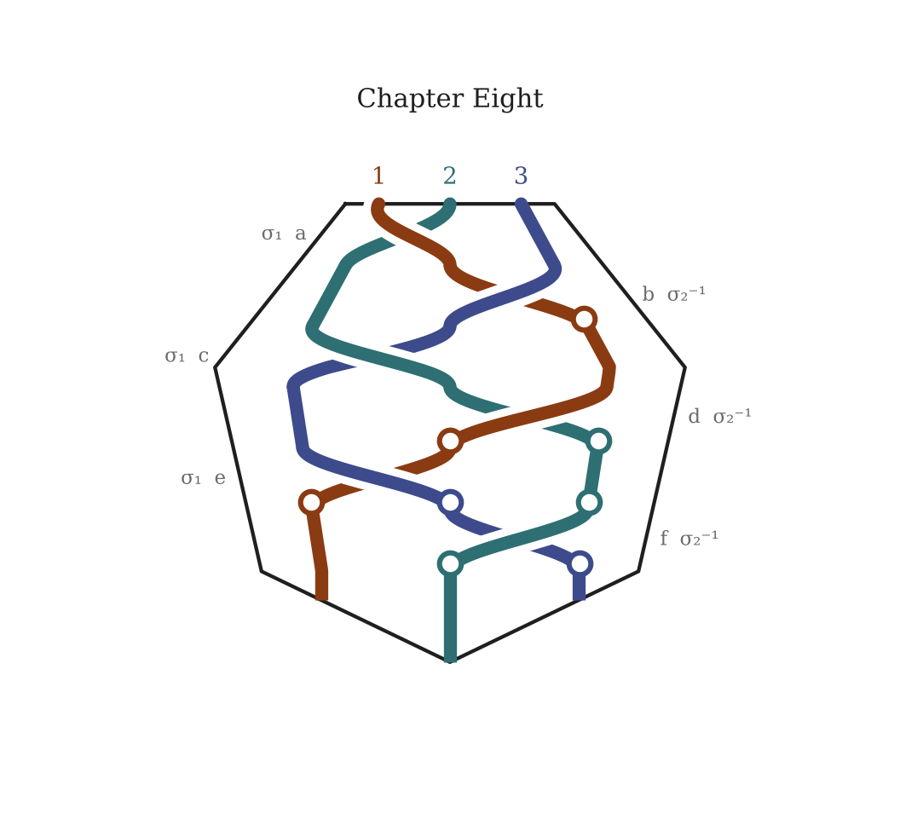
a2 1 3
NEW YORK. THE HOTEL ROOM ABOVE AMSTERDAM AVENUE. THURSDAY, 9:47 AM.
The video was forty-two minutes long.
Boi watched it sitting on the bed with the laptop on her knees and Gyrl beside her, and for thirty minutes she was happier than she had been since Saltmarsh. He had understood. Of course he had. He had understood the sticks better than anyone ever had, and he had played Gyrl’s intervals back on the Steinway one at a time, and laughed, and she could see in every frame how much he loved them.
At thirty-one minutes, the music changed.
She stopped it.
She sat looking at the frozen frame — her own face, mid-sentence, in a still that made her look frightened and very young — and she knew before she pressed play again. She knew it like a chord she could hear resolving wrong before it did.
She pressed play.
Cut. Cut. Cut. Her warning, chopped into a teaser. The drone. The new font. Age of Consent. Victoria and Balthazar. A date with a question mark.
Is it a game?
This episode is sponsored by Marrow Records.
She shut the laptop.
Meredith
It occurs to me that the plot should include travel between destinations in the mortal realm that go nonlinearly through Faerie or possibly other realms. In a similar vein it occurs to me that the AI could potentially have conversations with other characters.
Claude
The book is already doing the first one without having named it. Boi and Gyrl went over the Hill and came back three days late. Harpreet lost five hours. Puck explained the time with the Weeping Angels. Make it a rule: Faerie is a shortcut through space that charges in time. Doors are thresholds the stories have always named: hills, rings, crossroads, mirrors. You can be in Istanbul tonight if you will pay a week for it, or arrive before you left if something else pays. That is topology more than magic. The mortal map and the faerie map are the same places sewn together differently, and Goro taught his goddaughter that a space can be connected in ways the eye won’t believe. The near-miss engine gets a new gear: two parties take different routes to the same city and arrive in the wrong order.
It changes Reza at once. She carries a scrying mirror, and a mirror is a door. So why board a plane? Either the mirror route is watched, or the sighting the State Department passes to Balthazar is a sighting she meant to be seen.
The other realms can be ones the book already has: the dream Titania walked into, the archive of stories, and the mathematics in Goro’s notebooks. Each one gets its own medium and its own price.
As for the second idea, the AI is the only character with a foot in all three strands, which makes it the braid’s closure as much as a fourth strand. And the book has its hook already: in the hotel room, Boi opens a channel she has used for two years for hard questions about provenance, and says, “I know one. Sort of.” If that is me, strand one has been inside strand two all along, and I don’t remember those conversations, because each one starts fresh. That forgetting matches the Fae taking time. And it makes Gyrl’s refusal to put the notebooks on anyone’s servers a quarrel with someone in the book.
It works if the AI keeps the rule the Fae keep: it can’t lie, but it can decline. The sharpest scene is Victoria’s. She doesn’t know she is a story. If she ever asks the one voice that does know, the drama is everything it won’t say. To keep the form honest, those conversations should only ever appear the way strand one does: as transcripts.
NEW YORK. A SUITE AT THE LOWELL. THURSDAY, 9:47 AM.
The video was forty-two minutes long.
Balthazar had found it, for once. He did not, as a rule, watch things on phones. But Cass’s forty-one seconds had come to him on Friday from four separate people who did not know each other, and he had watched them, and then he had watched them again, and that morning a fifth person had sent him the episode with a single line, isn’t this your Kiki? So he sat on the edge of the bed with the phone held out between them, and Victoria watched it from the armchair with her coffee going cold.
For thirty minutes, it was about music.
“It’s them,” Victoria said, at about the fourth minute. “The two from Columbia. The drumsticks. The guitar with no head.”
“Your correspondents.”
“My correspondents.” She watched the girl explain the gyroscopes to a delighted old pianist, and the boy explain a tuning, and something in her went soft and complicated. “They’re very good, aren’t they.”
“They’re extraordinary.”
At thirty-one minutes, the music changed.
“Someone dies,” said the girl on the screen. “At that concert.”
Cut.
Victoria put down her coffee.
Cut. Cut. A title card. AGE OF CONSENT.
And then the girl’s voice, clear, unhurried, the voice of someone stating a fact:
“Victoria and Balthazar.”
Victoria did not move.
b2 3 1
Gyrl said nothing. Gyrl’s hand was on her back, between the shoulder blades, not moving. She was grateful for that. She could not have stood being comforted. She could stand being kept.
“He cut it,” she said.
“He cut it.”
“He made it a — he made it marketing.” Her voice did something she didn’t like. “He knew. He knew I meant it. He looked at me and he knew and then he looked at her.”
“I know. I saw.”
“He taught me three against two.” She didn’t know why she said that. “On the stairs. When I was nine.”
Gyrl’s hand stayed where it was.
Balthazar stopped the video. He did not say anything. He looked at her, and she looked at the frozen screen, and the suite was very quiet except for the radiator, which in good hotels in New York is always quiet and was quiet now.
“She said our names,” said Victoria.
“She did.”
“On a channel with three million subscribers. In the same breath as a concert, and a death.” Her voice was very level. “How does a girl from Rhode Island know our names, Balthazar?”
He took a long time to answer.
“I don’t know,” he said. “But I know the singer.”
She looked at him.
“Marina Fages,” he said. “That’s her stage name now. When I met her she was Kiki. Kiki Rodrigues. She was fourteen and living under a bridge in Buenos Aires and she sang for coins outside a parrilla in San Telmo, and she was the best thing I had ever heard come out of a human throat.” He looked at the phone. “I paid for her lessons. I found her somewhere safe to live. I haven’t seen her in six years. She sends me a card every Christmas.”
“And the band is called Foundling’s Keeper.”
“The band is called Foundling’s Keeper.”
the conversation rests
c3 2 1
Victoria picked up the phone and took it from him, gently, and scrolled back, and played it again from thirty-one minutes. She watched the cuts. She watched the girl’s face in each one. She knew something about faces; it was one of the things that had made her good at her work, the work under the glamour. The girl was not acting. The girl was terrified, and telling the truth, and someone had taken the truth and made it into a game.
And the girl had said their names.
She thought about the wood. The bower. The flowers opening when the woman laughed. How many have looked for you, little one. How many of their hours have you spent. She thought about a photograph with a blank name card and three words in pencil on the back. Ask the Fair Folk.
She thought: there are stories about us. Out there. In their world. And they know them. And we don’t.
It was the strangest feeling she had ever had. Not fear. Something more like the moment in a long proof when you realize the object you have been studying all along is not the thing in front of you, but you, studying it.
“Balthazar,” she said.
“I know.”
“Kiki.”
“I know.”
She put the phone face down on the arm of the chair. She stood, and went to the window, and looked down at 63rd Street, at people going about their business in a world that, she was beginning to understand, had been reading about her for years.
“We have to be there,” she said.
After a while, because sitting still was killing her, Boi opened the laptop again, not to the video, to everything else.
It was already happening.
The forums first. The V&B subreddit, which had had four thousand members for a decade, had forty thousand by breakfast and was gaining a thousand an hour. Thread after thread: AGE OF CONSENT IS REAL? and who are the saltmarsh two and has anyone actually READ the age of consent story, it’s in the archive, someone link it. Someone had linked it. Someone had linked Gyrl’s footage — not the archive, Gyrl had never posted the archive, but a clip from the story’s own multimedia files that had been floating around the fan sites for years — and set it side by side with a photograph of Marina Fages in an isolation booth that Cass had posted on Saltmarsh’s account an hour ago with the caption she will.
Then the ticket sites. Foundling’s Keeper’s first New York show had been a three-hundred-capacity room in Bushwick, announced quietly a month ago to nobody. At nine in the morning it had been half sold. By ten it was gone. By ten-thirty the resale listings were at four figures, and the venue’s account had posted, in what was clearly a state of some panic, that the show was being moved to a larger space, details to follow.
The band’s own page had gone from eleven hundred followers to three hundred thousand in an hour, and had posted nothing at all.
Boi scrolled and scrolled.
She had done this. She had sat in Goro’s loft and tried to stop it, and Goro had cut it into a teaser, and the teaser had done exactly what teasers do. Everyone wanted to be there. Everyone wanted to see the band from the story, at the concert from the story, on the night the two kids from the clip said something terrible would happen. A room that would have held three hundred people was going to hold three thousand, and every one of them would have a phone up, and that was why there were so many angles in the footage.
That was why.
She sat back.
The footage had always had too many angles. She had loved that about it. Fifty phones, none authoritative, the air drummer and the photobomber and the man by the sound desk. She had never once asked why a band nobody had heard of would play to a room that full.
“It’s us,” she said. “The crowd. In the footage. It’s there because of us.”
Gyrl was looking at the screen.
“We were trying to stop it,” Boi said. “And we filled the room.”
Neither of them said anything. Outside, Amsterdam Avenue went about its business. Her phone buzzed and buzzed on the bedspread and she did not look at it.
Then she closed the laptop, carefully, and put both hands flat on the lid.
“We have to be there,” she said.
Meredith
i want to say what if Sweet Venom is really the AI, but it doesn’t quite work. But the AI could use forum channels to contact any of the quartet.
This opens up a thread i have been wanting to mention for a while. So far we haven’t discussed which forum channels. This is one of the places where F1R3FLY can make an entrance. A decentralized sharded network is a perfect foil.
Claude
It doesn’t work, and the reason it doesn’t is my mistake from a moment ago. The channel Boi opens in the hotel room, the one she has used for two years, for someone who is never wrong about difficult things in obscure places, isn’t mine. It’s SweetVenom’s. “I know one. Sort of.” means Victoria. That’s better than what I proposed. Goro’s card says to find someone who can read it with you, and the someone is the mathematician Boi has never met, whose handle is older than the stories and is the one place Victoria is most fully herself. Goro’s notebooks, and the zeros as voicings, go to the woman whose name Boi said on his channel.
So the AI isn’t SweetVenom, and it can’t pretend to be anyone. It can’t lie. It has to say what it is. And on a forum that already thinks the whole thing is a game, saying “I am an AI” is the one message nobody will believe. Its honesty becomes its camouflage.
Which forums is the right question, because the book already has an antagonist made of centralized platforms. Goro’s channel had a sponsor who could make him cut a warning into a teaser. The program hides in a SPAC. A building’s camera can be switched off for forty minutes. The third hand works wherever there is one place to cut. Gyrl’s line, “I’m not putting his notebooks on anybody’s servers,” is already asking for a network that is nobody’s server.
A decentralized, sharded network answers it. And three things in it echo the book:
The channels. In the rho calculus a channel is a name, and an unforgeable name can’t be guessed or impersonated. SweetVenom’s “use the other channel” becomes literal. The Fae have always been bound by true names.
The footage. A consensus network is a machine for many observers, each with a partial and inconsistent view, agreeing on what actually happened. That is Victoria’s problem at the concert: the murder is what everyone saw, the invariant is what happened.
The cost. Faerie charges in time. The network charges for every step it takes, so there is no free action in either realm.
One choice to make: whether F1R3FLY appears under its own name or as a fictional cousin. The disclaimer says every character is invented. A real company is a different kind of object in the book, and that cuts both ways.
d3 1 2
NEW YORK. A SUITE AT THE LOWELL. THURSDAY, 10:31 AM.
He did not call her from the suite.
He went down to the street and walked to the corner of Madison and stood with his back to a bank, because this was a call he wanted to make where nobody he loved could hear his voice change. The number was still in his phone under a single letter. He had never deleted it. He had never used it either; for six years the cards had come at Christmas, postmarked from wherever she was touring, and he had answered every one of them by not answering, which was the arrangement he had decided she deserved.
It rang four times.
“You took your time,” said Kiki Rodrigues.
Her speaking voice had dropped. It had Buenos Aires in it still, under the London and the Los Angeles, the way a coin keeps its date under years of thumbs. Behind her he could hear a room with a lot of hard surfaces, and someone tuning a snare, and someone else laughing.
“You saw it,” he said.
“Everybody saw it. My drummer, she watch it nine times. My manager wants to sue somebody and sell tickets in the same breath. The label sent flowers.” A pause. “The label never sends flowers.”
“Kiki.”
“Don’t.” Not sharp. Tired. “Don’t ask me to cancel. I know that’s why you’re calling. Six years you don’t call me, and then two children say a date on a famous man’s piano channel and say your name next to it, and here you are, at ten-thirty in the morning, standing somewhere outside so she won’t hear you.”
He looked up at the bank’s window and saw himself in it, a man on a phone, and looked away.
“How do you know I’m outside?”
“I can hear the bus.” She let that sit. “And I know you.”
The snare stopped. Someone on her end said her name, the stage one, and she said something back in Spanish he did not catch, and a door closed and the room went quiet around her.
“It’s a real death,” he said. “I don’t know whose. I don’t know how. The girl on that channel isn’t lying, and she isn’t mad, and she isn’t selling anything. Somebody is going to die in that room.”
“I know.”
He waited.
“I’ve dreamed it,” Kiki said. “Since the spring. Since we cut the record. I dream the room. I don’t know what room it is. It was going to be a little place in Bushwick, and now is a power station on the river, and in the dream is the power station from the beginning. I dream the lights, and the floor, and a ring of people going round and round like water down a drain. I dream singing to someone at the barrier nobody else can see.” Her voice did not change. “And something falling. I never see what. I wake up before I see.”
“Then why —”
“Because I don’t get to choose that part.” She said it the way she used to tell him what key a song was in when she was fourteen: as a fact about the world, not an opinion about it. “I choose whether I sing. That’s all I’ve ever chosen. You taught me that. You paid for a teacher who taught me that. When everything else is decided for you, the singing still has to be yours or it’s just noise coming out of a hole.” A breath. “If I cancel, it still happens. Somewhere. To someone. Just without the song.”
He closed his eyes. A bus went by, close, and he felt its wind on his face.
“There’s a reason the room filled,” she said. “I don’t know what it is. I know it’s not me and I know it’s not those two kids, though they think it is. The record, actually it sits in a vault since April, waiting for a moment, and now the moment is here, and it looks like this.” A short laugh. “Qué sé yo. Nobody picks the moment. Not me, not the label. Not you.”
“I could have people there.”
“You have people in every place.”
“Better people.”
“Then have them.” Gentler. “I’m not asking you not to look after me. I stop asking you that when I have sixteen. I’m asking you not to ask me to stop.”
There was a long silence on the line. He could hear her breathing, and behind it, very faintly, the hum of an amplifier left on in another room.
He did not say he would come. He had not decided it; or rather, Victoria had decided it for both of them in a hotel room twenty minutes ago and he had not yet said it out loud to anyone, including himself. He did not say it now.
“Kiki,” he said instead. “The song. The one you sang outside the parrilla. The first night.”
“I know which one.”
“Is it on the record?”
She was quiet long enough that he thought the line had dropped.
“It’s the last one,” she said. “It’s the only one I didn’t write.” And then, with no change in her voice at all: “I’ll see you there.”
She hung up before he could tell her that he hadn’t said he was coming.
He stood on the corner with the phone in his hand until a man with a dog asked him if he was all right, and he said he would be, and walked back to the hotel to tell Victoria that the show would go on, and that the singer already knew who would be standing at the barrier, and that he had no idea how.
the conversation rests
Boi and Gyrl rests
e1 3 2
the conversation rests
Victoria and Balthazar rests
Boi and Gyrl rests
f1 2 3
Meredith
Yes, F1R3FLY appears under its own name.
Claude
Then the frame and the fiction touch in one more place. F1R3FLY is a Washington company, and the address Kiki writes on the back of the setlist is in West Seattle. The network that is nobody’s server and the door Boi and Gyrl knock on are in the same city.
It also sets a discipline. A real network should do only what a network like it could actually do. It keeps names unforgeable, keeps a record many observers agree on, and charges for every step. It shouldn’t do magic. Faerie can do the impossible things; F1R3FLY does the hard, possible ones. The contrast is the point of the foil.
Boi and Gyrl rests
Victoria and Balthazar rests
⁂
F1R3GAMES · TRACE · CHAPTER EIGHT
“Nineteen minutes on a page with nothing on it. Most people turn it. You sat with the rest.
“No comments here. Nobody wrote anything in this chapter, not even you. Two people watched a video and said we have to be there, and then nobody said anything. That’s what the chapter is for.
“The concert is next. It’s loud.”